Fish news
Fish news
 

Fish and aquatic news

July 8, 2008

Opposites attract

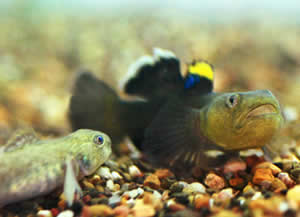
A study done on Perissodus microlepis, a cichlid from Lake Tanganyika in Africa shows that opposites attract. The cichlid is a scale eater that eats scales from other fishes. Specimens have a mouth that either open to the left or the right. This adaptation makes it easier to tear scales from other fishes when feeding. The study showed that this species prefers to pair up with a partner that has a mouth that opens the opposite way of their own. During the course of the researches who completed the study (2004-7) caught 24 Perissodus microlepis pairs. 21 of those pairs had their mouths facing opposite sides. This is the first time disassortative mating have been confirmed in the wild. (Disassortative mating is to choose partners who differ from oneself to avoid inbreeding.)

The study was done by Japanese researchers including Kyoto University researcher Tetsumi Takahashi and was announced Wednesday in the online edition of “Biology Letters” published by the Royal Society.

Add to Del.cio.us RSS Feed Add to Technorati Favorites Stumble It!
   www.sajithmr.com


July 2, 2008

Catfish eats fotball, dies!

Filed under: Fish
Tags: , , , , ,
William @ 8:45 am

A large wells catfish tried to eat a football (soccer ball for you Americans) in the city of Würzburg, Bayern, Germany. The catfish couldn’t swallow the football and go its teeth stuck in the ball after biting down on it. It is believed that the wells catfish couldn’t get the ball out of its mouth again and suffocated. The catfish was a little over 2 m / 7 ft long.

You can see pictures of the catfish by clicking here. The article itself is in Swedish so it might not interest most of you.

Picture of weels catfish

Picture of monster wels catfish
Copyright www.jjphoto.dk

Add to Del.cio.us RSS Feed Add to Technorati Favorites Stumble It!
   www.sajithmr.com


June 23, 2008

Fishing orangutangs

Filed under: Endangered, Environmental, Fishing
Tags: , ,
William @ 2:00 pm

orangutan
A series of photos have been published of an orangutan fishing using a spear while hanging out over the water from a branch. The orangutan in the pictures is a male living in a
sanctuary on the island of Kaja in Borneo. This reserve offers home for animals that have been displaced and homeless by logging and other development. As orangutan have a hard time spearing swimming fish it spears fish stuck in nets and lines. Another orangutan used the method to “catch” floating fruit. It is believed that the orangutans have learned this by observing local fishermen. You can see the pictures by clicking here.

Orangutans are highly endangered and some scientist warns that they might be gone from the wild within 10 years of not drastic measure are taken to protect them.

Add to Del.cio.us RSS Feed Add to Technorati Favorites Stumble It!
   www.sajithmr.com


June 18, 2008

Ghost nets

It has long been now that ghost nets (lost nets drifting in the ocean) are a serious problem to the marine environment but no one has ever really known how big the problem is until now. Scientists working for the Northwest Straits Initiative have monitored ghost nets in Puget Sound and the impact they have on the wildlife by regularly check the nets for dead fish and birds as well as the degree of decomposition. They noted species, decomposition rate and tagging newly-entangled animals to collect as much data as possible.

They found that fish caught in ghost nets decompose in 10 days or less. This makes it hard to really see the damage the et causes as the evidence of the deaths they cause soon vanishes.

One net the monitored are calculated to have killed 2,300 fish and 1,200 marine birds during its 15 years as a ghost net.

The program has also removed 870 ghost nets from the sea. In those nets they found 30,000 entangled animals, including 22 dead marine mammals, 378 dead birds, 1,022 live and dead fish, and 29,517 live and dead invertebrates.

You can read more about the Northwest Straits Initiative, the study, and its results here.


Add to Del.cio.us RSS Feed Add to Technorati Favorites Stumble It!
   www.sajithmr.com


June 16, 2008

It´s a baby

Today I thought I would report on some happy news, animal babies being born in aquariums around the country.

The first happy occasion is that a beluga whale in the Vancouver Aquarium has given birth to a health young female. The whale gave birth during open hours and the staffs as well as visitors watch the calf being born. This is the mothers’ first birth.

Breeding whales and dolphins in captivity is important to avoid having to catch new specimens in the wild: many aquariums including the Vancouver Aquarium have a policy against obtaining new whales ad dolphins in the wild.

You can read more about this birth here:

Another happy occasion is about to take place in the Georgia Aquarium where a rare weeded se dragon is pregnant. The male (yes you read right, It is the male that carries the eggs) carries about 70 fertilized eggs and he is expected to give birth in early to mid-July. The Georgia aquarium have been trying to breed this species and recently made a number of different changes to the setup to try and trigger spawning. Apparently it worked. This is only the 3rd time this species is breed in an aquarium in the US.

Read more here


Add to Del.cio.us RSS Feed Add to Technorati Favorites Stumble It!
   www.sajithmr.com


June 15, 2008

Invasive species

Filed under: Environmental
Tags: ,
William @ 10:22 am

Todays post will not report on any news. Instead I have choosen to post two videos that I think some of you might find interesting. They are from a invasive species symposium and are all about invasive species and what can be done about them. The first part is a about invasive species regulation and the second part about invasive plant life.

Be warned. Each of these videos are almost an hour long.

Regulation:

Plants and weeds:

Add to Del.cio.us RSS Feed Add to Technorati Favorites Stumble It!
   www.sajithmr.com


June 13, 2008

Yes. It is a unicorn!

Filed under: Weird
Tags: , , , ,
William @ 10:41 am

Well not really but it is close enough to report on even if it isn’t fish related. In a nature reserve in Italy in the town of Prato, Tuscany, there is a deer that has only one horn in the center of its head. The dear, named unicorn, was born in captivity in the research area of the park and is believed to be a genetically anomaly. Another theory suggest that his unicorn look might be due to an injury the deer might have suffered when young. Although deers sometime only have one horn it is very rare, if not unknown to have a deer with one horn in the middle of the head. More commonly they just lack the left or the right horn. It has been suggested that this anomaly regardless of it cause might be the source for the myth about the unicorn.

You can read more about it and see pictures of the deer by clicking the link below.
http://www.msnbc.msn.com/id/25097986/

Add to Del.cio.us RSS Feed Add to Technorati Favorites Stumble It!
   www.sajithmr.com


June 12, 2008

Interview with Dr Dean Pomerleau

fish training

Today we have a special feature here at the AC fish news blog. An interview with Dr Dean Pomerleau who train fish to do tricks. I posted about her work about a week ago in the post “Playing basketball with your goldfish?and he has been kind enough to answer a few questions about his work and how to train fish. I know all of you would like to start reading the interview rather than my ingress so without further ado, here is the interview.

Lets start with a little about you. What’s your background?

I have a PhD in computer science / robotics. In my “real job”, I develop collision warning system hardware and software for cars and trucks. Specifically, systems that warn the driver when he’s drifting off the road due to drowsiness, inattention or distraction.

How come you started to train fish?

golfish trainingA little over two years ago, my kids (Kyle now 12, and Kendall now 9) wanted a dog, but my wife is allergic and a neatness fanatic. Plus dogs are a lot of work to take care of, and we weren’t sure that we our the kids (or their parents!) were ready for the responsibility. So we bought fish as a substitute. But the kids weren’t entirely satisfied - fish aren’t cuddly, and aren’t (usually) very interactive.

So one weekend day Kyle and I were sitting around looking for something to do, and we thought “wouldn’t it be cool if we could make our pet fish more interesting by training them.”

It has just snowballed from those humble origins.

Why Goldfish?

It is what we had. We’ve also trained other fish since then, including Betta, oscars, and parrot cichlids.

Have you ever tried to train fish that is generally considered smart than goldfish such as larger cichlids. Oscars as an example are know to be easy to teach tricks and some other large cichlids do best if they get a toy like a ping pong boll to amuse themselves with if kept alone?

Yes - check out the videos on our website (http://www.fish-school.com/gallery.htm) of our two trained albino Oscars (Snow and Ice). Snow was particularly good (and aggressive) at soccer. We had to get a bigger ball, since he was 5-6 inches at time. He’d pick up the tiny ball we’d been using for our goldfish in his mouth and swim around with it. We were worried he might swallow it!

Can you give our readers any tips if they want to train there fish?

I’d definitely suggest they purchase our kit, available at several on-line retailers. We’ve put a lot of careful research and engineering into the 20 pieces of equipment that come with the kit, and a lot of great information in the instructional DVD and printed manual. It includes step-by-step instructions to train your own fish at home to do all the tricks show in our video of Comet. To see the video, and learn more about the kit, your readers will want to visit http://www.r2fishschool.com.

Goldfish playing fotballWhat is your goal with training fish?

Two goals really:

1) to bring the fun hobby of pet fish training to people everywhere, - especially kids. It helps teach persistence, patience, the power of positive feedback, even personal hygiene!

2) to raise awareness of fish sentience. I’m a long time vegan, and advocate for animal welfare. I like the fact that because of our success training fish, people everywhere are reconsidering the stereotype people have of fish in general (but especially goldfish) of having only a 3 second memory. Fish have a lot more going on ‘upstairs’ than they are given credit for, and deserve better treatment than they are given, either on our plates, or in crowded, polluted ‘fish farms’.

It was very gratifying when I was told a story about someone having seen one of our videos and deciding on the spot to stop eating fish, saying “if fish can do that, I’m not going to eat them anymore!”.

For more background, on motivation and philosophy, see:

http://blog.fish-school.com/2007/12/fish-school-philosophy.html

Do you see any practical application of your work? Will we see guard fish in the future?

Yes - definitely.

Goldfish trainingExamples include underwater mine detection:

Trained fish for underwater mine

fish behavior management at zoos and aquariums:

Fish training at pittsburgh aquarium
Ppg aquarium visit part 1: sharks
Ppg aquarium visit part 3

“fish ranching”:

Fish ranching to replace fish farming

and entertainment:

Trained fish as actors

What is the purpose of fish-school.com?

The goal of our website is entertain visitors, motivate them to try the fun hobby of fish training for themselves, and educate them about fish sentience.

What´s next for you and your work?

My goal right now and for the next year or two is to really help the new hobby of pet fish training take off. We’re excited to have a kit that people can now use to train their own fish at home.

I’m particularly enthused about a partnership we’re in the process of setting up with one of the leading distributors of science kits to primary school around the country. We are putting together a unit that will help teachers to use pet fish training in the classroom to teach the principles I mentioned earlier - persistence, patience, the power of positive feedback, even good personal hygiene!

It will be very gratifying to know that kids everywhere are learning important values based on what we’ve done.

Thanks for answering our questions Dean. I really appreciate you talking the time to do so.

Add to Del.cio.us RSS Feed Add to Technorati Favorites Stumble It!
   www.sajithmr.com


June 11, 2008

Mediterranean tuna fishermen use illegal air surveillance to find blue fin tuna

Filed under: Fishing
Tags: , , , , ,
William @ 7:00 am

Working together WWF and Greenpeace have obtained evidence that the tune fleet working in the central Mediterranean is using airplanes to find tune. This practice is internationally banned in the Mediterranean as it allows the oversized fishing fleet to catch to much tuna and make to big damage to the tuna population. Read more about this here

Blue fin tuna fetches a very high price on the international market and the species is becoming increasingly threatened by over fishing. Illegal fishing operations are common. Although attempts are being made to internationally limit the fishing and restrict the fishing quotas (or even ban fishing for a few years) little progress is made due to the economic value of this fish. Recently however a number of encouraging actions have been taken by individual nations and private interests. One such action is that one of the biggest sea food whole sellers in the UK that sell to a lot of top restaurants etc have stopped selling blue fin tune due to the unsustainable fishing for this species.

Add to Del.cio.us RSS Feed Add to Technorati Favorites Stumble It!
   www.sajithmr.com


June 9, 2008

A deadly delicatessen is no longer so deadly

Almost everyone have heard about fugu, and how fugu and fugu liver is considered a delicatessen in Japan. In case you haven’t I can tell you that Fugu is a type of pufferfish and if it isn’t processed correctly it can kill you due to being poisonous. However now there is an alternative. Farmed fugu that is poison free and that doesn’t have to be processed by a specialist. This is done by giving them tetrodotoxin-laden bacteria free food without which the fish liver don’t turn toxic. About 7000 fish fed this way have been tested and all have been poison free. Only 1 of 3 wild caught puffers contain enough poison to kill. This has started an intense debate in Japan on whether or not to remove the restrictions that ban the trade and sales of fugu liver and that thereby restricts the entire fugu trade as it causes restrictions on who can process the fish and remove the livers. The farmers of poison free fugu say that it is safe and that the restrictions should be lifted for farmed fugu liver. Other like the vice president of the National Fugu Association thinks that fugu liver is always dangerous and that not enough is know to remove the restrictions. Also involved in the fight are large business organizations like Shimonoseki Fugu Association that controls large section of the fugu trade but that stands to lose a large share of their business if the restrictions are lifted. Other Japanese claims that it isn’t really the delicatessen they love if it can’t kill you and that a part of the trill is that the fugu sometimes contains a little toxin that can numb your lips even if cooked correctly.

The outcome of this is unknown and how much impact it really will have can be discussed either way as Fugu liver are widely sold and the authorities turn a blind eye to this. The item is seldom on the menu but is sold openly.

A few Japanese die each year from eating Fugu.

90% of the fugu consumed is farmed. The farming of fugu has increased quickly as the natural stocks are being depleted.

Source. NYTimes.com

Add to Del.cio.us RSS Feed Add to Technorati Favorites Stumble It!
   www.sajithmr.com


June 6, 2008

Playing basketball with your goldfish?

Filed under: Fish, Weird
Tags: , , , , , ,
William @ 7:13 am

Dr Dean Pomerleau has managed to teach his two year old goldfish Comet to play football, basketball, push a rugby ball over a set of posts, play fetch with a hoop, limbo dance under a bar, and zigzag through a series of poles.

Dr Dean Pomerleau used positive reinforcement to teach the fish. Positive reinforcement has since long been used to train dolphins and other marine mammals. “With the correct tools and the basic promise of a food reward, fish can very quickly learn complex tricks - like the limbo, zigzag or playing fetch” says the fish trainer to The Sun.

You can read the whole story in Jenny Eagle’s article in The Sun.

http://www.thesun.co.uk/sol/homepage/news/article1126255.ece

Add to Del.cio.us RSS Feed Add to Technorati Favorites Stumble It!
   www.sajithmr.com


June 5, 2008

Fish ice cream, anyone?

Filed under: Weird
Tags: , , ,
William @ 5:35 am

A technology that can be used to prepare nutrition enriched ice cream using fish has been developed by Central Institute of Fisheries Technology (CIFT), one of India’s leading fishery research institutes, Newindpress.com reports. The technology can also be used to enrich noodles.

Just like most other modern ice-creams, the “Maricream” produced by CIFT contains water, suger, butter and egg white, as well as stabilisers, emulsifiers and flavouring substances. What makes it so species is that its major ingredient is cooked cuttle fish.

Afraid of smelling fishy? Don’t be – the ice cream has been deodourised to remove the smell of fish.

Read the full article in the Indian e-paper Newindpress.com

http://www.newindpress.com/NewsItems.asp?ID=IEB20080512151841&Page=B&Title=Business&Topic=0

Add to Del.cio.us RSS Feed Add to Technorati Favorites Stumble It!
   www.sajithmr.com


June 4, 2008

The Beijing Olympics tainted by animal cruelty!!

GoldfishThere have been a lot of controversy around the Beijing Olympics, People being removed from their homes to make room for the Olympic village, Homeless people being shipped out of the city to hide them from the visitors and of course the situation in Tibet.

This time the controversy is about animal cruelty. No it is not about the Chinese eating dogs, It’s about one of the tourist souvenirs sold at the Olympics based on the cartoon fish, Beibei, that is one of the mascots for the Beijing Olympics. Vendors are selling a keyring with a small plastic bag containing a live goldfish.

The plastic bag has been sealed giving the poor goldfish only hours to live before they suffocate. Many goldfish meet their doom even sooner as the bags are made out of poor material and often break when carried on the busy streets of Beijing. The key rings are unfortunately selling very well.

The bags are sealed at the manufacturer and many goldfish die before they even get to the vendor. When the consumer buys them the goldfish might only have minutes last to live. Unfortunately as earlier said this doesn’t seem to stop this product from becoming popular.

A Spokeswoman from the RSPCA made a statement yesterday saying “We are shocked and appalled. It is a gimmick and shows no respect for the animals at all.” about the souvenir.

I can only speak for myself and say that this terrible souvenir will taint the Olympics for me and I can’t understand that a product like that is allowed anywhere. I would like to recommend everybody to spread this news and write about it in their blogg to increase awareness about this atrocious souvenir. If we can prevent just one of them from being sold it is worth it.

Add to Del.cio.us RSS Feed Add to Technorati Favorites Stumble It!
   www.sajithmr.com


Bermuda volunteers licensed to impale lionfish within the one mile limit

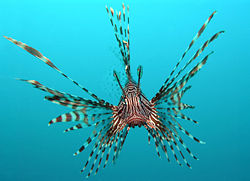
The lionfish is native to the tropical Indo-Pacific region, but this fish – also known as Dragon fish or Turkey fish – has now invaded the warmer coral regions of the Eastern Atlantic Ocean and Caribbean Sea.

To combat the problem around Bermuda, 31 volunteers have been issued special licenses by the Ministry of the Environment and Sports to engage in spear fishing of lionfish within the one mile limit that is legislated for spear fishing activities, The Royal Gazette reports.

The Lionfish constitutes a real threat to Bermuda’s reef ecosystem and commercial fishery. It is incumbent on us in Bermuda to do all we can to protect our marine ecosystem. In fact, even though this problem is relatively new to Bermuda, we are already being hailed by other countries and international organisations as an example of proactive management of Lionfish.” minister of the Environment Elvin James said to The Royal Gazette.

Several species of fish the family Scorpaenidae are known as lionfish, but the species causing trouble around Bermuda is Pterois volitans. It is believed to have been introduced to the ecosystem by saltwater aquarists in Florida. In order to better understand Pterois volitans and the effect it might have as an invasive species, the Department of Conservation Services will be collecting Lionfish from local waters and study them.

If you see a lionfish in the waters around Bermuda, contact the Marine Conservation Officer at 293 4464 extension 146 or email lionfish@gov.bm. The Marine Conservation Officer wish to know date, location and depth, and the approximate length of the fish (from snout to tail tip). The Marine Conservation Officer might need to contact you for further questions, so leave a phone number or email address.

Don’t try to catch the fish, because lionfish can give you a venomous sting with its fins. If you’re stung by a lionfish, seek medical attention right away. The sting is really painful.

You can read the full article in The Royal Gazette, Bermuda’s only daily newspaper.

http://www.royalgazette.com/siftology.royalgazette/Article/article.jsp?articleId=7d85e3330030009&sectionId=60

Add to Del.cio.us RSS Feed Add to Technorati Favorites Stumble It!
   www.sajithmr.com


June 3, 2008

World’s oldest livebearer found in Australia

A 380 million-year-old pregnant fossil has been discovered by researchers from University of Western Australia. The fossil was unearthed in the Kimberleys and contains a 6 cm embryo with its umbilical cord intact. Mother and baby belong to an extinct species of shark-like fish that could be found in lakes and seas for almost 70 million years before it disappeared. This is the oldest example of a mother of any species giving birth to live young.


This is also the first evidence of sex in vertebrates with jaws resulting in the oldest known example of a fish giving birth to live young rather than expelling a clutch of eggs,” says Dr Kate Trinajstic, Research Associate at the University of Western Australia, to News.com.au.

The fossilized species has been given the name Materpiscis attenboroughi. Mater is the Latin word for “mother” and piscis is the word for “fish”, so the genus name literary means mother-fish in Latin. The second part of the name, attenboroughi, is of course an homage to celebrated broadcaster and naturalist Sir David Attenborough. The fossilized fish belongs to the placoderm fishes, a group of fish commonly referred to as ’the dinosaurs of the seas’ since they dominated lakes and seas during the Middle Palaeozoic Era (c. 420 to 350 million years ago).

The fossil has now been given a new home at the Western Australian Museum.

Read the full story in Narelle Towie’s article at News.com.au. At this page, you can also see pictures of the fossil and drawings of what the fish might have looked like when it was still alive.

http://www.news.com.au/perthnow/story/0,21498,23772231-948,00.html?from=public_rss

The fossil find was published in the science journal Nature on May 29 this year.

Add to Del.cio.us RSS Feed Add to Technorati Favorites Stumble It!
   www.sajithmr.com


Newer Posts »