Marine Aquarium
In this section of AC Tropical Fish, you will find information about all kinds of marine aquariums and the creatures that inhabit them. In addition to both rare and commonly kept species of marine aquarium fish you can find information about a long row of other maritime beings that can be kept in aquaria – perhaps you wish to try keeping sea anemones, jellyfish or an octopus?
For many fish groups, such as angelfish, blennies, pufferfish, and seahorses, we have special sections with detailed articles about popular as well as more unusual species. We also have sections about stationary creatures like corals, gorgonians, and sea anemones, as well as sections focused on mobile invertebrates such as nudibranchs, sea stars, snails, and shrimps. Last but not least, we have included a section focused on all the different types of equipment that is utilized by marine aquarists.
If you fail to locate a particular fish species in one of the article sections, take a look in the tropical marine fish database instead; it contains brief information on numerous species.
Keeping marine aquariums
The tradition of keeping marine creatures in tanks goes back to at least the Ancient Romans who liked to gather beautiful anemones form the Mediterranean Sea and place them in jars as decoration. They did however fail to keep their anemones alive for any considerable amount of time and the jars had to be constantly refilled with new anemones from the sea. Today, a devoted aquarist can keep an anemone alive for many years in the aquarium.
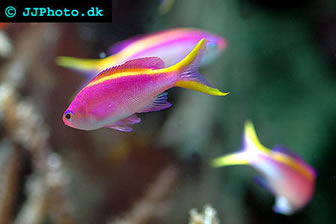
The main reason why so many aquarists decide to spend the extra time, money and efforts that a saltwater aquarium require is that a saltwater aquarium can house a wide range of animals that you could never keep in a freshwater aquarium. It will for instance be possible for you to keep vibrantly coloured marine fish species like clownfish, wrasses, anthias and the so called marine betta. A saltwater aquarium can also be filled with live corals, anemones, sponges, worms and so on. In the saltwater aquariums of advanced aquarists you can even find jellyfish, octopus and other large invertebrates.
Is a marine aquarium difficult to maintain?
Keeping a marine aquarium is typically more difficult than keeping a basic freshwater aquarium. There are naturally exceptions to this rule, some aquarists have freshwater aquariums that contain species that are extremely hard to keep and breed in captivity. It is also possible to create a basic saltwater aquarium that beginner aquarists can handle, as long as you are prepared to gather a lot of information and develop your knowledge on the subject before you set up the aquarium. Even advanced freshwater aquarists should read through the guidelines before they create a saltwater aquarium, since the ecology of a marine aquarium differs a lot from that of a freshwater aquarium.
 Copyright www.jjphoto.dk |
How expensive is a marine aquarium?
Generally speaking, a marine aquarium will be more expensive to set-up than a freshwater aquarium since marine species tend to be quite pricey and require high-priced equipment to survive, but there are of course exceptions to this rule. A freshwater aquarium filled with delicate and high priced species naturally be more costly than a basic marine aquarium filled with tolerant and fairly inexpensive marine species. It is possible to set-up and maintain a rather cheap marine aquarium if you go for readily available marine creatures that do not require pristine water quality.
FO, FOWLR or REEF
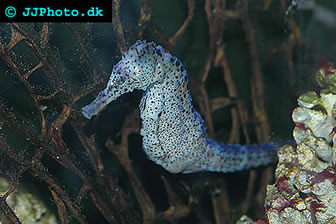 A sea horse in a marine aquarium Copyright www.jjphoto.dk |
Marine aquarium setups are commonly divided into three broad categories: Fish Only (FO), Fish Only with Live Rock (FOWLR), and Reef Aquariums. A reef aquarium resembles a true reef environment and will typically contain various types of coral as well as other reef invertebrates, e.g. worms, shrimps and anemones. Many reefs aquarium are actually kept without any fish at all.
So, what is this mysterious “live rock” used when setting up a marine aquarium? It is not the rock itself that lives; they name is used for (very dead) calcium carbonate skeletons or similar calcareous items inhabited by various marine organism. Exactly which organisms that your live rock will contain will always come as a surprise since a live rock can house anything from tiny bacteria and algae to sponges and mobile invertebrates. Some creatures may not become noticeable until you have had the rock in your aquarium for several months since they need time to grow and establish themselves in the tank. Live rock is not only used to introduce interesting surprise organism to the aquarium; they main purpose is actually to make the aquarium more similar to the real ocean by adding organisms that can help build up a tiny ecosystem. Live rock will help you keep the water quality up and the organisms can also serve as food for the species you wish to keep. Live sand – sand inhabited by various oceanic organisms – is also popular in marine aquariums.