Category Archives: Sharks & Rays
Increasing numbers of juvenile whale sharks arrive to Ningaloo Marine Park
According to a new report from Ningaloo Reef, the number of whale sharks in its waters is on the increase. The study, published in the journal Endangered Species Research (ESR), was made possible thanks to ECOCEAN – a new type of online photo-identification technology.
The system works by encouraging members of the public to send in their photos of whale shark, photos which are then stored in the in a database. Once they are in the data base, scientist can identify each whale shark using the pattern-recognition software.

Baby whale shark in the Phillipines.
Picture by WWF PF. Support WWF
The new technology in combination with the aid of citizens makes it easier for scientists to learn more about the migratory habits of the whale shark, the world’s larger fish. Prior to the 1980’s there were no more than 350 confirmed sightings of whale shark around the globe.
Since the project first began in 1993, over 500 new individual whale sharks have been discovered at Ningaloo Reef.
“Why are more and more juveniles arriving on the reef? It’s unclear, but it’s positive news,” says Jason Holmberg, lead author of the study.
Brad Norman, founder of the ECOCEAN whale shark project and Murdoch University, says the research shows that whale sharks can increase where they are well-protected.
“We have also demonstrated the power of citizen-science, that ordinary people around the world can make a real contribution to serious research and conservation,” he says. “Thanks to increasing levels of data collection, we’re finally able to estimate how many whale sharks appear annually, how long they typically remain at Ningaloo Marine Park (NMP), their patterns of arrival and departure and shifts in their population structure.”
In some countries whale sharks are still harvested commercially, while others have shifted over to whale safaris which can generate a substantial income through ecotourism. The researchers from Curtin University have shown that whale shark ecotourism can be advantageous for local communities around whale shark ‘hotspots’ such as the Ningaloo Reef.
“Our results indicate that without whale sharks at Ningaloo Marine Park (NMP) up to $4.6 million* would be lost from the local economy,” says Norman.
The success of the online collaboration between scientist and citizens has prompted researchers to issue a worldwide call to vacationers and divers to join in a global effort to monitor and protect the whale shark. You can find more information at www.whaleshark.org.
* 4.6 million AUD equals roughly 3.4 million USD
Shark dumped on doorstep
In Australia, a live shark was dumped on the doorstep of The Standard’s Raglan Parade office in Warrnambool shortly after midnight on April 22.
Fortunately for the shark, a local resident passed by, saw the shark, and alerted the police.
“I’d just come out of McDonald’s and there was another gentleman there and he told me there was a shark on the doorstep,” the man said to the Standard. “I thought he must have been drunk . . . but I put a spotlight on it and the shark was just sitting there perfectly still and you could see its gills going.“
Since the man didn’t have a phone with him, he drove to the police station, hoping someone there would believe him.
“I said to the policewoman at the counter: ‘I’m not sure how to explain this but there’s a shark on the front door of The Standard and it’s still alive’ and she said ‘what?’. It’s not something you hear about every day.“
The man said he drove home and told his girlfriend, who didn’t believe him. To convince her, he took her to The Standard’s front door where they found police officers busy pouring water over the poor shark to keep it alive.
The officers responsible for saving the shark and bringing it back to sea were Constable Jarrod Dwyer and Acting Sergeant Greg Cresell who, after pouring water over the animal, loaded it into their divvy van and transported their unusual passenger to the ocean.
“I nursed it on the front seat (of the divvy van) and we took it to the breakwater and put it back in the water near the boat ramp,” Constable Dwyer said. “It was literally right on the doorstep of The Standard.” He said the shark swam off when placed in the breakwater.
Acting Sergeant Cresell said it was one of the most bizarre incidents he’d come across in his time as a police officer.
“We’ve had some strange things in the van before but never a shark,” he said. “We wanted to save it and the longer it was out of the water the worse it was for it.”
The approximately 60 cm long fish has been identified as a Port Jackson shark by Ian Westhorpe, senior fisheries officer with the Department of Primary Industries. The Port Jackson shark is a common southern species but not often taken on a hook.
Not returning a fish to the water if you don’t intend to keep it is an offence, Westhorpe explained, and it will usually result in an on-the-spot fine.
“These laws are there to encourage the humane handling of fish,” Westhorpe said.
He also added that a Port Jackson shark isn’t dangerous to humans, except for the two venomous dorsal spines located near the dorsal fins.
Warrnambool police are investigating the incident and wish to speak with anyone with information.
Is the secret birth place of the whale sharks located in Philippine waters?
The tiny whale shark caught off the Philippine coast near San Antonio on March 6 has been confirmed by WWF to be the smallest live whale shark on record ever to be captured and released in the Philippines and arguably also the smallest living whale shark ever to be scientifically recorded.
Picture by WWF PF. Support WWF
The impressive Whale shark, Rhincodon typus, is the largest fish on the planet. The biggest specimen regarded as accurately recorded was caught in Pakistani waters in 1947 and measured 12.65 metres (41.50 ft) in length, with a girth of 7 metres (23.0 ft) and a weight exceeding 21.5 tonnes (47,300 lb).
The small specimen caught near San Antonio was on the other hand no longer than 15 in (38 cm) and may be what biologists call a neonate, i.e. a newborn. This is very interesting, since we still do not know to which part or parts of the world Whale shark females migrate to give birth to their pups. The finding of this tiny pup has caused scientists to speculate that the Philippine waters might be one of the places on the planet where the biggest fish in the world is born.
So, how did this petite Whale shark end up in human hands? On the morning of March 7, word reached Tourism Officer Pedragosa that a whale shark had been caught near San Antonio the day before. Pedragosa immediately sent Butanding Interaction Officer Guadamor to inform the town’s Municipal Agricultural officer Rabulan, and at this point, Aca, WWF’s Project Leader in Donsol, the municipality in which San Antonio is located, also became involved. When a shark is caught, time is of course crucial – examining the animal is important from a scientific point of view, but you don’t want to subject the shark to more stress than necessary. Aca therefore joined the officers of tourism, agriculture, and interaction at the tourism office right away and together they hastily drew up an operational plan and headed for San Antonio. At this stage, Berango, Chief of Police of Pilar, had also been alerted and Ravanilla, Regional Director of Tourism, had informed the resorts closest to the site.
The Chief of Police met up with Aca and the ministers at the seashore, where they found not a gigantic whale but a small stick jammed into the sand with a rope leading away from it into the ocean. As they followed the rope, they saw that it was tied around the tail of the smallest whale shark they had ever encountered before.

Whale Shark – Picture GNU Licensed
The team examined the shark to make sure that it had not been hurt, gave it food, measured it and documented the unique find. Less then three hours after the report first reached the tourism officer, the shark had been safely transferred to a big, water-filled plastic bag and the team was now heading towards deeper water where the shark could be released. Releasing it close to shore was not considered safe enough since the shallows in this area contains a lot of nets.
All this action took place in Sorsogon, a Philippine province famous for hosting the largest known annual congregation of whale sharks in the world. The province has become a popular destination for vacationers interested in snorkelling with sharks and going on shark safaris, and WWF is therefore working with local residents to develop and improve sustainable eco tourism practices along the coast.
Guest blogger
I always enjoy seeing new marine and freshwater blogs emerging and in an attempt to support one new blogs I welcome David Shiffman as a guest author:
Hello!
My name is David, and I’m new to the world of science blogging. I’m a graduate student in Charleston, South Carolina, and my research focuses on shark ecology and conservation.
My friends at Fish and Aquatic News were kind enough to let me write a guest post here to encourage you to check out my blog, where you can learn lots about sharks, the threats they face, and how you can help! We frequently have dialogues with the public and other members of the shark conservation and marine science community through comments, and we’d love to have you all participate!
I write as WhySharksMatter on the marine science blog
www.SouthernFriedScientist.Wordpress.com
As you can tell from my handle, I believe that sharks are not only incredible animals worthy of respect, but they are important- they matter. Environmentalists will agree that conservation in general is a good thing. However, my goal is not just to convince those already predisposed to agree with me. Through my speaking engagements, classes I teach, and my writings, I hope to convince the general public that sharks matter and that we should help them.
I will never, in a career that I hope to devote to public education about sharks, claim that sharks are more important than people are. Though there are many people on this planet who I personally care far less about than I care about sharks, it would be downright insane to make that argument. Instead, I will try to convince all who will listen that humans are better off with sharks than we are without sharks. Human jobs and human interests are well served by protecting sharks.
There are three things I hope to convince you all about sharks during my time as a blogger at Southern Fried Science. I will expand on each of these-and more- in future posts.
1) Sharks are important to the ecosystem and the economy due to their roles as apex and keystone predators. Shark population declines have led to collapses in commercially important fisheries worldwide, and the loss of coral reef habitats has been attributed to the loss of sharks.
2) Sharks are in big trouble around the world! Overfishing and bycatch has led many species to drop in population almost 90% in my lifetime- and I’m not old enough to rent a car yet. By some estimates over 100 million sharks are killed a year, one of the least sustainable fisheries on Earth.
3) You can help! Whether you’re a professional scientist, a student (grad school, college, or even high school), or a member of the general public, there is something that you can do.
I hope you’ll stop by my blog regularly, read my writings and contribute to our dialogues through commenting! If anyone ever has any questions, I would love to answer them- I check SouthernFriedScience daily.
(Some material taken from SouthernFriedScience)
~WhySharksMatter
Great white shark turns our to have weak bite
A research group[1] studying the hunting ability of the great white shark has found evidence indicating that this notorious predator actually has a fairly weak bite. In several movies – including the legendary Spielberg film “Jaws” – the great white shark has been portrayed as a hunter blessed with an exceptionally strong bite, but the allegedly fierce jaw power of Carcharodon carcharias is now being questioned.
According to research leader Dr Daniel Huber of the University of Tampa in Florida, sharks actually have very weak jaws for their size and can bite through their prey mainly thanks to their extremely sharp teeth – and because they can grow to be so large.

Photo by Terry Goss, copyright 2006
“Pound for pound, sharks don’t bite all that hard,” says Dr Huber. Compared to mammals, sharks have amazingly weak bites for their size. Lions and tigers are for instance equipped with much more jaw strength than sharks when you account for body size. According to Huber, mammals have evolved much more efficient jaw muscles.
During the study, Dr Huber and his team studied 10 different shark species. The bites of small sharks were fairly easy to measure, while large sharks had to be knocked out and subjected to mild electricity in order to stimulate their jaw muscles.
As mentioned above, sharks don’t really need strong jaws since they can grow so large and are fitted with extraordinarily sharp teeth. In addition to this, they also benefit from having very wide jaws. When they tear an animal apart, they frequently use a sawing motion.
Dr Huber hopes that their study will lead to the development of protective swim wear and other types of shark-proofing gear.
If you wish to read more, you can find the study “Is Extreme Bite Performance Associated with Extreme Morphologies in Sharks?” in the journal Physiological and Biochemical Zoology.
http://www.journals.uchicago.edu/doi/abs/10.1086/588177?prevSearch=(shark)+AND+[journal%3A+pbz]
[1] Daniel R. Huber, Department of Biology, University of Tampa, 401 West Kennedy Boulevard, Box U, Tampa, Florida 33606;
Julien M. Claes, Marine Biology Lab (BMAR), Catholic University of Louvain, Bâtiment Kellner, niveau D-1, 3 place Croix du Sud, B-1348 Louvain-la-Neuve, Belgium;
Jérôme Mallefet, Department of Organismic and Evolutionary Biology, Harvard University, 26 Oxford Street, Cambridge, Massachusetts 02138;
Anthony Herrel, Department of Biology, University of Antwerp, Universiteitsplein 1, B-2610 Antwerpen, Belgium
______________________________________________________________________
New article here on AC Red-striped Rasbora
Shark jumps into water slide
A 12+ year old female reef shark kept in an aquarium at the Atlantis Resort in The Bahamas managed to jump out of its tank and onto a nearby water slide. She slid down the slide and into the swimming pool, where she was subjected to the chlorinated pool water. The aquarium staff immediately put her back in her own tank in an attempt to resuscitate her, but it was too late. The Atlantis Resort does not keep their sharks in chlorinated water; they use filtered water from the Atlantic Ocean since it is more similar to the natural environment of these animals.
According to the hotel, the shark ended up in the swimming pool after jumping over a 1 foot high and 18 in wide sustaining structure. The event took place at around 9:30 in the morning when the resorts waterscape had not yet opened for guests, so no vacationers were swimming in the pool at the time.
The Atlantis aquarists believe “the shark was startled by an unusual circumstance that we have no way of defining completely”.
Several species of shark are capable of leaping out of the water and the exact reason or reasons behind this type of behaviour are yet not fully understood. The longest sustained series of breaches ever recorded was performed by a Humpback Whale who did 130 separate leaps in less than 90 minutes in the waters around the West Indies.
Multi-million dollar marine life contraband ring busted by the Florida Fish and Wildlife Commission
A six-month long investigation by the Florida Fish and Wildlife Commission (FWC) has led to the arrest of seven adults and one juvenile in Tampa. The arrested persons are believed to have been involved in various illegal activates concerning marine life, including catching protected sharks, sea horses, peppermint shrimp and bay scallops in Floridian waters, and exporting illegally obtained marine life to Europe. They are also suspected of having sold bait fish and bait shrimp as food for human consumption.
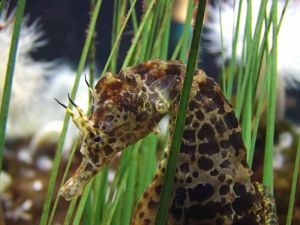
According to the FWC, the ring is believed to have operated for at least five years before attracting the attention of FWC. The ring lost a lot of animals due to poor maintenance, but the FWC still believes the group managed to sell $600,000 worth of peppermint shrimp alone.
The Florida Fish and Wildlife Conservation Commission came into existence on July 1, 1999. The Investigations Section of the commission conducts both overt (uniform) and covert (plainclothes) investigations, and one of their tasks is to target hard-core commercial violators by conducting long-term undercover investigations. In 2003, the Investigations Section made 554 arrests/warnings and seized 130 illegally possessed specimens of fish and wildlife including a cougar, tigers, leopards, primates, exotic deer, venomous reptiles, protected birds and exotic aquatic species.
Keys man punches shark to save his dog!
Last Friday, 53 year old Florida Keys resident Greg LeNoir saved his dog Jake from being devoured by a shark by jumping into the water and punching the predator.
The incident happened when LeNoir and Jake visited the Worldwide Sportsman’s Bayside Marina pier in Islamorada and Jake jumped into the water for his daily swim. According to LeNoir, Jake is a fast and fearless swimmer who loves to retrieve soaked coconuts and jellyfish. But this day, the playful swimming session took a turn for the worse when a five-foot (1.5 m) long shark showed up and chomped its teeth into the 14-pound (6.3 kg) rat terrier.
As LeNoir watched his dog suddenly disappear under the surface, he didn’t hesitate to come to his rescue. ”I clenched my fists and dove straight in with all my strength, like a battering ram,” says LeNoir. ”I hit the back of the shark’s neck. It was like hitting concrete.”
While being pounded by LeNoir, the shark decided to let go of Jake, who frantically swam back to the shore, leaving a red trail of blood behind him in the water. Jake was rushed to the VCA Upper Keys Animal Hospital in Islamorada, where his wounds were attended by veterinarian Suzanne Sigel and emergency on-call assistant Callie Cottrell. The sharp teeth of the shark had punctured Jake’s skin and some muscle, and skin was hanging like ribbons from his right side and front left leg, but he wasn’t in critical condition.
”He looks great and is recuperating well,” Sigel said on Monday. ”I was worried he may have inhaled salt water when he was pulled under, but there’s no evidence of infection or pneumonia.”
The hungry shark has not been identified, but LeNoir believes it to be a bull shark or lemon shark. Sharks are not uncommon in these waters, partly because the Islamorada Fish Company has an open saltwater pool which attracts large tarpon – a yummy treat for many species of shark.
Over 100 new sharks and rays named and described!
Australian scientists have now completed an 18-month long project aimed at scientifically describing sharks and rays, using traditional techniques as well as modern DNA sequence analysis. The ambitious project has resulted in over 100 species of sharks and rays being properly classified, which is equal to about one third of Australia’s known sharks and rays.

Southern Dogfish Image credit – CSIRO
Over 90 of the new species had already been identified by Dr Last and Dr Stevens in their book “Sharks and Rays of Australia” from 1994, but remained undescribed and without scientific names.
Many of the new species are endangered in the wild, such as the Maugean Skate and the Southern Dogfish, and having them properly classified and named is important for future monitoring and conservational work. The new descriptions and names will be included in a revised edition of “Sharks and Rays of Australia” which is planned for release in 2009.

Maugean Skate Image credit – CSIRO
The 18-month long study was backed by CSIRO’s Wealth from Oceans National Research Flagship. National Research Flagships are large-scale multidisciplinary research partnerships and the National Research Flagships program is one of the biggest scientific research endeavours ever undertaken in Australia.
If you’re interested in the Wealth from Oceans Flagship, you can find more information here. http://www.csiro.au/org/WealthOceansFlagship.html
Tagged White Shark Released From Monterey Bay Aquarium
The young white shark brought to the Monterey Bay Aquarium on August 27 has now been released back into the wild after 11 days on exhibit. She was captured on August 16 in Santa Monica Bay and has now been safely returned to the same waters. During her stay at the Monterey Bay Aquarium she lived in their million-gallon Outer Bay exhibit, but despite her relatively roomy accommodation she only fed once and the staff decided that she would be better of in the wild.

A white shark
“These decisions are always governed by our concern for the health and well-being of these animals under our care,” says Jon Hoech, director of husbandry for the Monterey Bay Aquarium.
On September 7, the young female was released in offshore waters in the Santa Barbara Channel at 1:30 p.m. (Pacific Time). Before being released, she was tagged with a tracking device that will provide researchers with data on her life in the ocean. For 148 days, the pop-up tag will collect information about geographical location, depths, and water temperature. After this period, the tag will pop free and deliver the collected data via satellite.
As of now, a total of four White Sharks with tracking tags have been released from the Monterey Bay Aquarium. The three other sharks did however stay longer at the aquarium before going a back to the wild; between four and six months. Together with their research partners, the Monterey Bay Aquarium has tagged and tracked 18 juvenile white sharks off Southern California as a part of their “White Shark Conservation Research Project”. The aquarium is also involved in the project “Tagging of Pacific Predators” (TOPP) led by Stanford University’s Hopkins Marine Station, which has tracked 143 adult white sharks off the Central Coast using data-collecting tags.
If you wish to know more about the white shark research at the Monterey Bay Aquarium you can visit www.montereybayaquarium.org/whiteshark/.