Category Archives: Fish
Fire crews try to help dying fish in Northampton
English fire crews were called out to aid dying fish in Northampton, BBC News reports. Members of the public noticed that fish had died in a lake in Abington Park and notified the authorities. The fire crews pumped up water from the lake and then sprayed it back in an effort to increase the oxygen content in the water.
The Environment Agency is now investigating the cause behind the incident. According to their tests, the problem was not caused by low oxygen levels and might instead be related to weather or disease. “It could have been low oxygen – although we have since found out this is not the case – it could be the hot weather or it could be disease. We don’t know at the moment.” an Environment Agency spokeswoman said to the BBC. The spokeswoman also caution against releasing aquarium fish into the wild since it can spread disease.
You can read more about the incident here: http://news.bbc.co.uk/2/hi/uk_news/england/northamptonshire/7394696.stm
Anyone who has information about the incident is asked to contact the Environment Agency.
Mysteries of the Colossal Squid Slowly Uncovered
Scientists at Te Papa Tongarewa, New Zealand’s national museum, have begun dissection of a colossal female squid this week, already the finds are worth documenting. The largest squid ever captured, is providing scientist with astounding insight into this mysterious creature of the deep. The first noticeable wonder on the over 1,000 pound squid was her eyes. Measuring in at 10.6 inches, just about equal to the size of a soccer ball, they are the largest eyeballs ever recorded for any known animal.
Perhaps the most fascinating thing learned thus far are two rows of bio-luminescent organs, called photophores, located under each eye. Scientists state that the “lights” are used to mask the squids attack of its prey. All the future meal would see was these small lights coming at it, due to the depth of over 3,000 feet; the lights would shield the squid from sight until it was too late. One problem comes from eating at such depths, most things consumed likely “glow” as well. But the colossal squid has a solution to keep its tummy from becoming a neon sign pointing out its location. The squids mantle (head) is filled with deep dark red pigment that shields any predators or prey from seeing anything within its stomach that might be sending out a glowing warning.
As fish numbers increase in the antarctic so do accidental catching of colossal squid, leaving scientists with the want to set up some form of conservation efforts to protect these mysterious creatures from becoming endangered or worse.
To read this article in its entirity please visit: http://news.nationalgeographic.com/news/2008/05/080501-giant-squid_2.html
Switzerland About to Make Big Changes For Fish

Starting September 2008 Switzerland legislation is going to be enforcing some new guidelines to for fish owners. Aquariums will no longer be allowed to be transparent on all sides, and any fish over 20cm will have to be housed in a tank/pond that meets the size restrictions that will be put into place. The new legislation also speaks of the importance of proper maintenance, and water quality, temperature, oxygen levels and salinity should be correct for the individual species being cared for.
Social Fish, to include goldfish, will no longer be able to be kept in a solitary habitat, but will require at least one friend. Forget about freezing your fishy friend or flushing it down the loo. From now on fish keepers will be required to stun the fish before killing it, using a non-prescription narcotic available to the general public.
To read this article in its entirety and see how the new legislation will effect anglers throughout Switzerland visit: http://www.practicalfishkeeping.co.uk/pfk/pages/item.php?news=1671
Amazon Molly using Genetic Tricks to Survive
Scientists from the University of Edinburgh believe that the Amazon Molly may be using genetic survival tricks to avoid becoming extinct. The species in Texas and Mexico interact with males of different species to reproduce. The fry are clones of the mother and never inherit any traits of the male. This species will soon develop problems reproducing and will often become victims to extinction.
At Edinburgh University, the scientists have studied mathematical models on a computing system to look at the case of the Amazon Molly. Researchers have decided that the time to extinction for the fish may be over many thousands of generations. They can now say that this fish should have been extinct within the past 70,000 years. Scientists think that the Amazon Mollies are still dwelling in the rivers of Southeast Texas and Northeast Mexico and are using the special genetic tricks to stay alive.
To read more on this visit http://news.bbc.co.uk/2/hi/uk_news/scotland/edinburgh_and_east/7360770.stm
Sturgeon to Find Love in Detroit River

Detroit Sky Line (picture by: Keith Syvinski)
The opportunity to reclaim once flourishing breeding grounds is now looking good for the sturgeon in the Detroit River. These massive fish that live over 100 years and can grow over 7 feet, are being given a helping hand in finding love. Once fished to near extinction, the sturgeon have fought against the odds to stay around; the pollution and runoff into the Detroit River however, destroyed their breeding grounds; but now years of Detroit River restoration efforts have finally provided clean water for breeding to be done in. The next step, rebuilding a breeding reef for the sturgeon to lay their eggs and rear their fry. The reef will cost a whopping $178,000, which has been paid for through foundations, the government, and other institutions.
To read this article in its entirety visit : http://www.freep.com/apps/pbcs.dll/article?AID=2008804280360
Newcastle’s Fight Against Platy

picture by: Philipp Rassel
Newcastle may be faced with a new threat to its natural species of fish, the platy. Typically a beginner fish, do to their sturdiness, the platys originate from Central America. Recently however, scientists in Australia have found this livebearer infesting their waters. It is especially concerning because their numbers grow quickly, being live-bearers. Platys also eat frogs and fry from fish spawning, leaving native species fighting against a growing tyrant.
Six platy were found in a drain connected to a main water supply in Newcastle; leaving scientist with the concern that they fish have found their way to the dam. If this is the case, it may be too late to control the situation. So how did they get there? Experts believe it is from, what they are now calling, “Finding Nemo Syndrome.” In the movie Finding Nemo by Disney and Pixar Studios, “all drains lead to the ocean.” The movie has led many inexperienced fish owners with the assumption that flushing unwanted fish is a proper way to dispose of them humanely. Thus, people introduce a new, non-native species into the waterways, which can cause major ecosystem troubles for the natives.
For Information on the proper way to dispose of an unwanted fishie friend Read the Article “Don’t Flush that Fish” by Shirlie Sharpe http://freshaquarium.about.com/cs/disease/a/noflush.htm
To read this article in its entirety visit: http://www.flmnh.ufl.edu/fish/InNews/threat2008.html
Giant Squid Going Under the Knife

Giant Frozen Squid. photo by: Hideki Saito
A giant female Squid caught by a New Zealand fishing boat in the Antarctic last year, is finally set to undergo dissection Te Papa. The squid weighed in at an astounding 490kilograms, or 1,080 pounds! Up until its capture, the squid has remained frozen, and is now in the process of being thawed out for dissection at the museum. The museum is planning on having a web video of the procedure, for those who want to watch. Scientists are hoping to find what this enourmous squid has been eating, by removing the stomach and examining its contents. The dissection should take a couple of days to complete.
To read the entire article (and to find the link to the dissection, live feed) please visit ONENEWS at: http://tvnz.co.nz/view/page/1318360/1746926
Photo provided by http://creativecommons.org/licenses/by/2.5/ (the use of this photo does not suggest creative commons endorses this article or veiw points presented on this topic)
Fisherman Catches ‘Lucky’ Horned Snakehead Fish in Malaysia
Saibi Ramli, a Malaysian fisherman, has caught a snakehead fish with a 2 cm (0.8 inch) horn on its head, Underwatertimes.com reports. Saibi Ramli caught the fish in a fish pond behind his home in Siburan, Kuching, using hook and bait. Ramli says he has never seen anything like it in his life and refuses to sell the catch since he is positive that the fish will bring him luck. “I have received many offers from wealthy people but I told them it’s not for sale”, Ramli explains.
You can read the full article and watch the picture of the horned creature at Underwatertimes.com. http://www.underwatertimes.com/news.php?article_id=45107920638 (source:http://www.brunei-online.com)
Asian Snakeheads, especially the Arowana Scleropages formosus, are viewed as bringer of luck by many Asians. Snakeheads are often referred to as “Dragon fish” in Asia, not chiefly because they somewhat resemble dragons but because they are seen as an incarnation of the mythological Asian dragon itself. In European fairytales the dragon is normally perceived as something evil that should be slaughtered, but this is certainly not the case in Asia. The Asian dragon is associated primarily with happiness and good fortune and keeping “Dragon Fish” in your aquarium is believed to attract luck to your home and ward of evil.
You can learn more about Asian Snakeheads here and about Scleropages formosus in particular here .
Russia has proposed a five year long ban on fishing sturgeon in the Caspian Sea
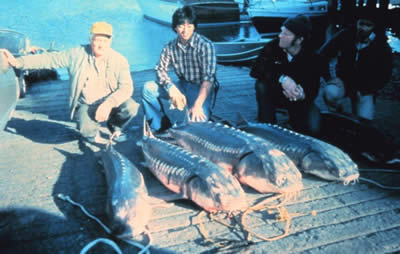
Credit: NMFS File Photo
Russia has proposed a five year long ban on fishing sturgeon in the Caspian Sea, News.com.au reports. According to non-governmental organisation Caviar Emptor, the Beluga Sturgeon population has declined by 90 percent during the last 20 years. Russia has suggested that all countries bordering the Caspian should impose a ban and that the ban should last for at least five years. According to Andrei Krainy, head of Russia’s state fisheries agency, Russia is ready to ban even scientists from fishing sturgeon in the Caspian Sea. The Caspian Sea is home to roughly 90 percent of the total sturgeon population. The sturgeon is primarily fished for its caviar eggs, a world-famous delicates.
You can read the full article here: http://www.news.com.au/story/0,23599,23444657-1702,00.html
The Caspian Sea is an enormous body of water without any outflows. Its coastline is shared by Russia, Iran, Azerbaijan, Kazakhstan and Turkmenistan. Its salinity is about 1.2%, while the average salinity of the ocean is 3.5%. The Caspian Sea is fed by over 130 rivers, including the famous Russian river Volga which is the largest river in Europe in terms of length, watershed and discharge. The Caspian Sea is home to several endemic species of fish, such as the Caspian roach and the Caspian white fish (also known as Kktum). The Caspian Sea is also where you will find the Caspian seal, one of very few seal species that live in inland waters instead of living in the ocean.
Snakeheaad Alley
A video about the snakehead situation in the Potomac river. In certain areas of the river snakeheads now are established and competing with local fish species such as local bass. Hopefully they will be kept confined to certain parts of the river and won´t spread to other parts of the country. We will just have to wait and see. in the meen time the snakehead is turning into a popular game fish luring sport fishers to the area. For more info see the almost 3 min long video.
Releasing caught snakeheads are illegal and catches should be reported to the local fish and wildlife service.