Category Archives: Fish
Pacific expedition discovers 13 new fish species
Marine biologists being filmed for a BBC TV series about the ocean have managed to find no less than 13 species of fish previously unknown to science. The group also reports having 15 other animals in their possession that they suspect to be new species.
The newfound species have been gathered during deep reef dives in Micronesia in the Pacific Ocean during explorations of the so called “twilight zone”. Located at a depth of 60 to 150 meters (500 to 200 feet), the twilight zone forms a transitional region between sunlit shallow waters and the perpetually dark depths of the sea.
One of the findings is of special importance to marine aquarists – a new species of damsel fish. Damsels are very popular among saltwater fish keepers since they are one of the most robust groups of marine fish and generally adapt well to a life in aquaria. The new damsel species was caught 120 meters down off Palau and sports a bright blue colouration.
The bright blue damsel was actually spotted over a decade ago by Dr Richard Pyle, and it has been occasionally seen since then by other researchers as well, but it was during the BBC filming that the species could be captured and brought up to the surface for scientific examination for the very first time. The fish has now been scientifically described and named by Dr Pyle from the Bishop Museum, Honolulu, Hawaii.
Recreational scuba divers with ordinary scuba gear are not advised to venture any deeper than 40 meters (130 feet), so the researchers of this expedition had to use special closed-circuit rebreathers to access the twilight zone. Even with rebreathers, you quickly run out of air at such a great depth and there is no time for any meticulous investigation of the environment.
The expedition will be portrayed in the BBC series “Pacific Abyss” and the new species of damsel have been appropriately named Chromis abyssus.
Pacific Abyss starts its three-part run on Sunday, 17 August, on BBC One, at 2000 BST.
Src: bbc.co.uk
A second and possibly third species of manta ray discovered
Genetic and morphological analysis has now confirmed the existence of a second species of manta ray, and possibly a third one as well. Up until know, the scientific community only knew about one single species of manta ray and all encountered manta rays were viewed as variants within the same species. PhD marine biologist Andrea Marshall did however suspect that there might be more than one species of manta ray luring in the ocean and in 2003 she to a small coastal village located in southern Mozambique to be able to study the manta rays found off the African coast. During the last five years, she has been carrying out a manta ray study sponsored by the Save Our Seas Foundation and discovered a new species as well as collected invaluable information about the reproductive habits of the manta rays.
The two manta rays species have overlapping geographical ranges, but they have significantly different life styles. One species is migratory while the other one – the smaller and more commonly known species – is resident to particular costal regions where it stays year round. There are also noticeable differences in reproductive biology, skin texture and colouration.
The small, stationary species is commonly encountered by divers and researchers at coral reefs, while the larger, migratory species is much more elusive.
The pectoral fins of a manta ray can span almost 8 meters in width and the weight of this baffling shark relative can exceed 2000 kg. Unlike the stingray, the manta ray is not equipped with a functioning stinging barb, but one of the manta ray species actually has a non-functioning type of sting on its tail.
According to the Save Our Seas Foundation, Andrea Marshall’s new finding is the marine equivalent of discovering an unknown species of elephant.
You can find out more by visiting the Save Our Seas Foundation (http://www.saveourseas.com/manta-rays-a-new-species) and the Mozambique Manta Ray project page (http://www.saveourseas.com/manta-rays-mozambique).
Clownfish to be considered endangered
Many of us may think about clown fish as commonly found reef fish but the fact is that many clownfish species might becoming endangered in some areas such as of the coast of Australia at least if we should believe Dr Billy Sinclair, University of Cumbria.. A big culprit is the aquarium trade. Just five years ago there were still plenty of clownfish out there but than come the very popular movie finding Nemo from pixar. The movie which was a success in theatres and have sold over 40 million DVDs created an instant demand for clown fish species looking like Nemo. (like the Percula clownfish) Even though a lot of clownfish is being bred in captivity each year the captive bred stock couldn’t satisfy the demand and therefore over-harvesting of wild specimens became a reality. Many (most) marine biologists agree with the effect the movie has created.
A problem is that people who buy them don’t know how to manage a marine aquarium and just set one up like they would a goldfish bowl. This often leads to death of the fish as the owners don’t know how to care for them or a saltwater tank.
Clownfish sales have gone up eight-fold since the movie was released and not only biologist like Dr Billy Sinclair see a decline in the wild populations. Divers also reports how much rarer it has become to see clownfish. It has also become much rarer for clownfish to be caught accidentally by commercial fishermen
The study done by Dr Billy Sinclair shows that shoals that used to number dozens of clownfish now only contain a few specimens. This makes it harder for the species to breed. In some area they are more or less gone completely. Hopefully however populations can recover quickly if the pressure from the collection of clownfish from the pet trade can be reduced. The pet trade is however not the only culprit in the population declines. Coral bleaching and die off (caused by rising temperatures) is also believed to play a role.
Opposites attract
A study done on Perissodus microlepis, a cichlid from Lake Tanganyika in Africa shows that opposites attract. The cichlid is a scale eater that eats scales from other fishes. Specimens have a mouth that either open to the left or the right. This adaptation makes it easier to tear scales from other fishes when feeding. The study showed that this species prefers to pair up with a partner that has a mouth that opens the opposite way of their own. During the course of the researches who completed the study (2004-7) caught 24 Perissodus microlepis pairs. 21 of those pairs had their mouths facing opposite sides. This is the first time disassortative mating have been confirmed in the wild. (Disassortative mating is to choose partners who differ from oneself to avoid inbreeding.)
The study was done by Japanese researchers including Kyoto University researcher Tetsumi Takahashi and was announced Wednesday in the online edition of “Biology Letters” published by the Royal Society.
Catfish eats fotball, dies!
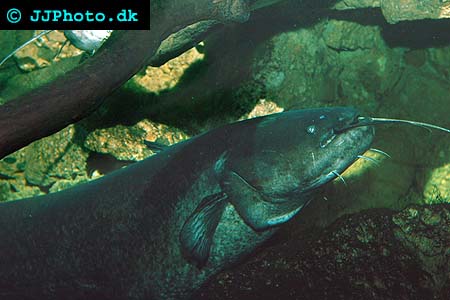
A large wells catfish tried to eat a football (soccer ball for you Americans) in the city of Würzburg, Bayern, Germany. The catfish couldn’t swallow the football and go its teeth stuck in the ball after biting down on it. It is believed that the wells catfish couldn’t get the ball out of its mouth again and suffocated. The catfish was a little over 2 m / 7 ft long.
You can see pictures of the catfish by clicking here. The article itself is in Swedish so it might not interest most of you.

Picture of weels catfish
Copyright www.jjphoto.dk
It´s a baby
Today I thought I would report on some happy news, animal babies being born in aquariums around the country.
The first happy occasion is that a beluga whale in the Vancouver Aquarium has given birth to a health young female. The whale gave birth during open hours and the staffs as well as visitors watch the calf being born. This is the mothers’ first birth.
Breeding whales and dolphins in captivity is important to avoid having to catch new specimens in the wild: many aquariums including the Vancouver Aquarium have a policy against obtaining new whales ad dolphins in the wild.
You can read more about this birth here:
Another happy occasion is about to take place in the Georgia Aquarium where a rare weeded se dragon is pregnant. The male (yes you read right, It is the male that carries the eggs) carries about 70 fertilized eggs and he is expected to give birth in early to mid-July. The Georgia aquarium have been trying to breed this species and recently made a number of different changes to the setup to try and trigger spawning. Apparently it worked. This is only the 3rd time this species is breed in an aquarium in the US.
Read more here
Playing basketball with your goldfish?
Dr Dean Pomerleau has managed to teach his two year old goldfish Comet to play football, basketball, push a rugby ball over a set of posts, play fetch with a hoop, limbo dance under a bar, and zigzag through a series of poles.
Dr Dean Pomerleau used positive reinforcement to teach the fish. Positive reinforcement has since long been used to train dolphins and other marine mammals. “With the correct tools and the basic promise of a food reward, fish can very quickly learn complex tricks – like the limbo, zigzag or playing fetch” says the fish trainer to The Sun.
You can read the whole story in Jenny Eagle’s article in The Sun.
http://www.thesun.co.uk/sol/homepage/news/article1126255.ece
The Beijing Olympics tainted by animal cruelty!!
 There have been a lot of controversy around the Beijing Olympics, People being removed from their homes to make room for the Olympic village, Homeless people being shipped out of the city to hide them from the visitors and of course the situation in Tibet.
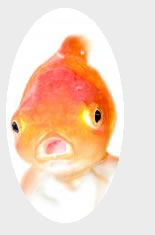
This time the controversy is about animal cruelty. No it is not about the Chinese eating dogs, It’s about one of the tourist souvenirs sold at the Olympics based on the cartoon fish, Beibei, that is one of the mascots for the Beijing Olympics. Vendors are selling a keyring with a small plastic bag containing a live goldfish.
The plastic bag has been sealed giving the poor goldfish only hours to live before they suffocate. Many goldfish meet their doom even sooner as the bags are made out of poor material and often break when carried on the busy streets of Beijing. The key rings are unfortunately selling very well.
The bags are sealed at the manufacturer and many goldfish die before they even get to the vendor. When the consumer buys them the goldfish might only have minutes last to live. Unfortunately as earlier said this doesn’t seem to stop this product from becoming popular.
A Spokeswoman from the RSPCA made a statement yesterday saying “We are shocked and appalled. It is a gimmick and shows no respect for the animals at all.” about the souvenir.
I can only speak for myself and say that this terrible souvenir will taint the Olympics for me and I can’t understand that a product like that is allowed anywhere. I would like to recommend everybody to spread this news and write about it in their blogg to increase awareness about this atrocious souvenir. If we can prevent just one of them from being sold it is worth it.
Bermuda volunteers licensed to impale lionfish within the one mile limit
The lionfish is native to the tropical Indo-Pacific region, but this fish – also known as Dragon fish or Turkey fish – has now invaded the warmer coral regions of the Eastern Atlantic Ocean and Caribbean Sea.
To combat the problem around Bermuda, 31 volunteers have been issued special licenses by the Ministry of the Environment and Sports to engage in spear fishing of lionfish within the one mile limit that is legislated for spear fishing activities, The Royal Gazette reports.
“The Lionfish constitutes a real threat to Bermuda’s reef ecosystem and commercial fishery. It is incumbent on us in Bermuda to do all we can to protect our marine ecosystem. In fact, even though this problem is relatively new to Bermuda, we are already being hailed by other countries and international organisations as an example of proactive management of Lionfish.” minister of the Environment Elvin James said to The Royal Gazette.
Several species of fish the family Scorpaenidae are known as lionfish, but the species causing trouble around Bermuda is Pterois volitans. It is believed to have been introduced to the ecosystem by saltwater aquarists in Florida. In order to better understand Pterois volitans and the effect it might have as an invasive species, the Department of Conservation Services will be collecting Lionfish from local waters and study them.
If you see a lionfish in the waters around Bermuda, contact the Marine Conservation Officer at 293 4464 extension 146 or email lionfish@gov.bm. The Marine Conservation Officer wish to know date, location and depth, and the approximate length of the fish (from snout to tail tip). The Marine Conservation Officer might need to contact you for further questions, so leave a phone number or email address.
Don’t try to catch the fish, because lionfish can give you a venomous sting with its fins. If you’re stung by a lionfish, seek medical attention right away. The sting is really painful.
You can read the full article in The Royal Gazette, Bermuda’s only daily newspaper.
World’s oldest livebearer found in Australia
A 380 million-year-old pregnant fossil has been discovered by researchers from University of Western Australia. The fossil was unearthed in the Kimberleys and contains a 6 cm embryo with its umbilical cord intact. Mother and baby belong to an extinct species of shark-like fish that could be found in lakes and seas for almost 70 million years before it disappeared. This is the oldest example of a mother of any species giving birth to live young.
“This is also the first evidence of sex in vertebrates with jaws resulting in the oldest known example of a fish giving birth to live young rather than expelling a clutch of eggs,” says Dr Kate Trinajstic, Research Associate at the University of Western Australia, to News.com.au.
The fossilized species has been given the name Materpiscis attenboroughi. Mater is the Latin word for “mother” and piscis is the word for “fish”, so the genus name literary means mother-fish in Latin. The second part of the name, attenboroughi, is of course an homage to celebrated broadcaster and naturalist Sir David Attenborough. The fossilized fish belongs to the placoderm fishes, a group of fish commonly referred to as ’the dinosaurs of the seas’ since they dominated lakes and seas during the Middle Palaeozoic Era (c. 420 to 350 million years ago).
The fossil has now been given a new home at the Western Australian Museum.
Read the full story in Narelle Towie’s article at News.com.au. At this page, you can also see pictures of the fossil and drawings of what the fish might have looked like when it was still alive.
http://www.news.com.au/perthnow/story/0,21498,23772231-948,00.html?from=public_rss
The fossil find was published in the science journal Nature on May 29 this year.