Breeding Clownfish
Thanks to Disney’s Motion Picture Finding Nemo, almost everybody knows about clownfish since they introduced Nemo to the world.
Clownfish, or Anemonefishes, from the family of Pomacentridae, are one of the easiest tropical marine aquarium fish to breed. Clownfish regularly lay eggs in aquariums. They have pretty large eggs and larvae, and since the larvae easily eats cultured live foods, raising them is somewhat simpler then it tis with many other marine species..
You need to get a pair if you want to breed clownfish and you need to sex the fish. And that’s a quite an interesting part – believe it or not, clownfish are all born as males! When they are adults, the largest and the most dominant fish of the group will undergo a sex change, and become a female. The second largest usually becomes the breeding male, while all the other fish remains juveniles and gender-neutral. If the breeding female disappears, the breeding male will change to a female, and so on. Buying an established pair maybe a reasonable way to go, but it is often better to have a group of juveniles growing up together. If you choose to buy a pair you should look for a pair that goes around together. Sometimes you can be lucky enough to get a pair already spawning. Anyhow, establishing an adult pair can be a little tricky; and you need to keep your eyes on them to ensure that the female doesn\’t kill the male.
The next thing is about setting up the tank. The tank should be large enough, approximately 200 liters for the breeding pair. It is better to let the pair be alone in an aquarium when trying to spawn clownfish.
The rest of the aquarium should be decorated with a nice anemone, a few live rocks, and other rocky substance with a vertical surface, a layer of coral sand on the bottom, bright lighting, good filtration, and protein skimmer. The aquarium and your clownfish should be stressed free which means no aggressive tank mates and good water quality. As for the feeding, clownfish need a mixed diet of fresh raw seafood and vegetable. A good diet includes prawns, mussels, and squid. It is best to feed small bits at regular periods.
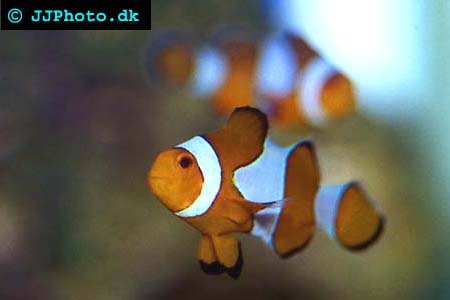
Percula clownfish – Amphiprion percula.
Copyright www.jjphoto.dk
Spanning can begin 1 to 12 months after the fish have settled into their new home. When the fish are ready to spawn, they become very aggressive. The male clownfish will dance up and down in front of the female (also known as “clownfish waggle”). They will also start to clean their selected rock by robustly biting it. The spawning itself usually occurs in the afternoon or early evening. Once the spawning is complete (within several hours) the male takes on responsibility for attending them, whereas the female acts as protector of the eggs and supervisor of her male.
The spawning is likely to be occurred again at intervals of 12 to 18 days. The eggs should be left in their care and not removed, except if the parents are known to be egg-eaters. At first, the eggs are a bright orange color, which after a several days diminishes and the eyes appear. Hatching usually takes from 6 to 15 days, depending on the temperature. The most critical stage of the fry is the stage they undergoes in the first 10 days of their larvae span. If you can get your fry to survive this period the rest of their raising should be more easy.