Algae & How to get rid of it
Contents
What is algae?
Algae (sing. alga) are simple organisms that typically produce their own food through photosynthesis. They are similar to higher plants, but they lack many of the distinct organs that you will find in a higher plant. The higher plants are believed to have evolved from algae, and algae are believed to have gotten their capacity for photosynthesis from cyanobacteria.
Some types of algae are capable of absorbing organic carbon through osmotrophy, myzotrophy or phagotrophy and are therefore not forced to rely solely on photosynthesis. Osmotrophy is a process where dissolved organic compounds are absorbed through osmosis. Myzocytosis is a method (sometimes referred to as “cellular vampirism”) by which the algae will suck out cellular content from other cells through a feeding tube. An alga that carries out phagocytosis will engulf solid particles with its cell membrane to form an internal food vacuole.
Algae can be unicellular as well as multicellular. Large and complex forms found in the ocean are commonly referred to as seaweed and can look very similar to higher plants. Algae are voluntarily and involuntarily kept by many aquarists. Some species are very beautiful and well-liked, while others are shunned and meticulously exterminated from the aquarium. There are also many types of algae that can help you keep the water quality up in the aquarium by binding substances known to be harmful to fish and other aquatic animals and exude oxygen in exchange. Algae can turn the aquarium into a better functioning ecosystem and allow the animals to carry out more of their natural behaviours in captivity.
Algae are not only something encountered by aquarists and pond keepers; they can occur in virtually all moist environments including swimming pools and bathrooms. Certain types of algae are also appreciated as food throughout the world.
Algae are an important part of the ecosystems where they occur, but they can also become a nuisance for aquarists, pond keepers and swimming pool owners. In order to successfully combat algae it is important to understand what algae are and how they subsist. Just like a land living plant, algae need light, water, nutrients, carbon dioxide and oxygen. Oxygen is produced as a bi-product of photosynthesis and getting enough carbon dioxide and water is rarely a problem in aquariums, ponds and swimming pools. The main limiting factors are therefore light and nutrients. By controlling the amounts of light and nutrients, we can carry out successful algae control in ponds, aquariums and swimming pools.
Algae types
Types of algae
There are several thousand known species of algae in the world and they occur in many different colours and forms. Algae can for instance be green, blue-green, brown, red or black.
Some types of algae will drift around in the water, while others grow attached to a surface, e.g. a rock, coral or plant leaf. There are also types of algae that float on the surface since this is the place where they can receive the most light.
In everyday speech, algae are commonly divided into three main groups based on appearance: microscopic algae, filamentous algae and attached-erect algae.
Microscopic algae
Microscopic algae waft along freely in the water. They form the autotrophic part of the plankton, the diverse group of drifting organisms that inhabits the pelagic zone of everything from oceans to small bodies of water. The name plankton is derived from the Greek word πλαγκτος (“planktos”) which means “wanderer” or “drifter”. Microscopic algae are commonly referred to as phytoplankton. Distinguishing the individual alga with a naked eye is generally not possible, but large groups of algae can be detected since the chlorophyll inside them turns the water greenish. Some types of microscopic plankton will give the water another colour than green, since they contain accessory pigments.
Filamentous algae
In filamentous algae the individual algal cells will stick to each other and form long, hair-like strands. The strands can form entangled clumps in the water and pieces can break off to float on the water’s surface. Several species of filamentous algae are known to be cold tolerant and an algae bloom can therefore occur even during early spring when the water is relatively cold in temperate parts of the world. The bloom will typically start in shallow parts where the light reaches all the way down to the bottom. Clear water will further enhance the lights ability to reach far down.
Attached-erect algae
Just as the name suggests, attached-erect algae grows attached to a surface, such as a rock, and will grow more or less straight up from the bottom. Many species of attached-erect algae can grow really tall and be very similar to land plants. When studied more closely, there are however significant differences between this type of algae and land living higher plants. Since attached-erect algae can be so similar to higher plants, pond owners sometimes mistake them for each other and try in vain to combat the algae with methods developed for ridding ponds of higher plants, e.g. lotus flowers. Many anglers dislike attached-erect algae since it can ensnare fishing equipment.
Green Algae
Green algae is a large paraphyletic group of algae from which the higher plants (the embryophytes) developed. There are over 7,000 known species of green algae and green algae can be found in a wide range of different habitats all over the world. A majority of the species are unicellular or filamentous algae living in freshwater, but other forms of green algae exists as well and you can find green algae in both saltwater and brackish environments.
Almost all known forms of green algae are equipped with chloroplast filled with chlorophyll a and chlorophyll b, just like higher plants, and this is why they are green. Green algae also contain the secondary pigments in the form of carotenes, lutein and zeaxanthin, and sometimes even siphonoxanthin. Another similarity between higher plants and green algae is that they both store starch (amylose or amylopectin).
Green algae will typically have cellulose in their cell walls and all species have mitochondria with flat cristae. Quite a lot of the species are flagellates with two flagella for each cell, which makes it possible for them to propel themselves. The flagella are normally anchored by microtubules, but there are exceptions to this general rule.
As mentioned above, green algae can be unicellular or form colonies. In members of the order Charales, which are comparatively close relatives of the higher plants, full differentiation of tissues do occur.
Green algae in the aquarium
You might find green algae unsightly, but it is actually part of the natural ecosystem in the aquarium and your fish won’t mind sharing their home with some green algae. On the contrary, many fish species and other aquatic creatures enjoy grazing green algae and having natural algae growth in your aquarium makes it possible for them to carry out their natural behaviour in captivity.
Many other types of algae, e.g. hair algae, is a signal to the aquarist that something has gone wrong with the water quality, but green algae is known to occur even in aquariums with perfect water quality. If the green algae start growing much faster than before, there is however a few things you can do to keep the algae growth in check.
- Light
The green alga gets its energy from photosynthesis and will therefore depend on light for its survival. Reducing the amount of light that reaches the aquarium can hamper the growth of green algae.
- Nutrients
Green algae use the same type of nutrient as higher plants and including a lot of live plants in the set up will therefore force the algae to compete for food. In addition to this, it is important to carry out regular water changes and avoid over-feeding. Do not let the levels of organic waste rise, because this can easily lead to excessive algae growth in the aquarium.
- Manual cleaning
You can manually clean away the green algae, but you have to be persistent because it will soon be back again. Manual cleaning should therefore ideally be combined with other types of algae prevention, e.g. keeping the levels of organic waste down.
- Algae eaters
There are many creatures that love to feast on green algae. Before you get algae eaters for your aquarium, make sure that they will appreciate the tank mates, water chemistry, temperature, and so on, of your particular aquarium. Different algae eaters are ideal for different aquariums. Don’t limit yourself to fish only; sometimes snails or other invertebrates are a much better choice.
Hair Algae
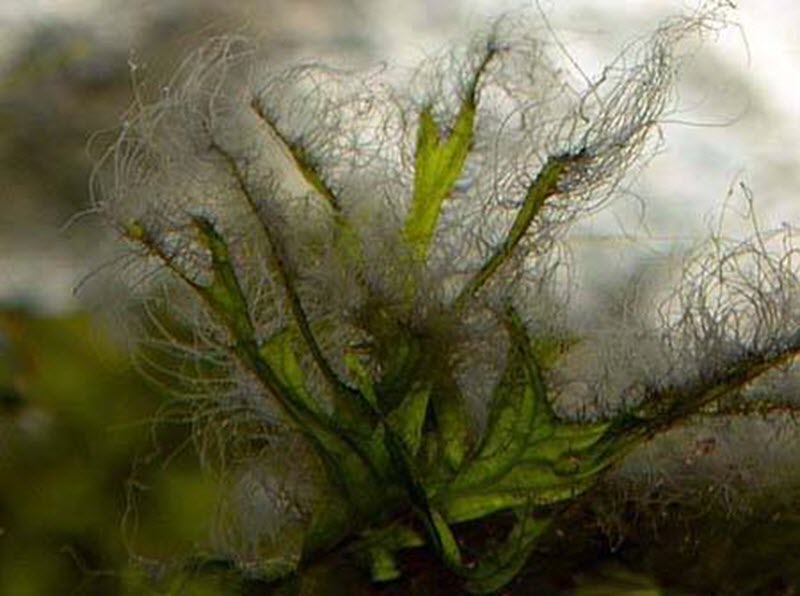
Hair algae is a light green or green-gray type of algae that can become a nuisance in the aquarium. In a favourable environment, hair algae and grow really fast and an aquarium can therefore become filled with long, green “hairs” in no time. Even after a good manual scrub, the algae can be back within a few hours.
Hair algae are capable of growing attached to most types of surfaces, from stones and aquarium decorations to glass, equipment and plants. Hair algae might look unsightly in the eyes of the aquarist, but it has its own role to play in the ecosystem and quite a few organisms like to feed on hair algae. In the limited space that is an aquarium and with too few natural enemies and too few plants and other types of algae to compete with for light and nutrients, the hair algae can however become a problem not only for the aquarist but for the inhabitants as well.
Hair algae will often show up together with thread algae in aquariums.
How can I control hair algae in the aquarium or pond?
- Water management
Hair algae thrive when the nitrate levels are allowed to exceed 10 ppm and a sudden hair algae boom in the aquarium is often a sign of poor water management. Check the water quality on a regular basis and carry out frequent water changes. It is also important to avoid over feeding. Some aquarists have managed to get on top of a persistent hair algae problem by switching to live food only. Live food that stays alive until eaten will not increase the nitrate levels as much as uneaten dead food.
- Competition
As mentioned above, hair algae will thrive in an aquarium where there is an abundance of available nutrients (e.g. fish waste). One way of reducing these amounts is to include live plants in the set up. Live plants need the same types of nutrients as algae and will therefore compete with the algae for food.
- Hair algae eating creatures
If you want to use algae eaters to control the algae, make sure that you pick suitable species. To begin with, the species must be suitable for your particular aquarium. Many algae eaters are forced to live in aquariums with an unsuitable pH-level, temperature, tank mates and so on, because the aquarist is only interested in their algae eating ability and does not care about the fishes/invertebrates and their well being. Secondly, get algae eaters that love to eat hair algae. Many algae eating species are not very fond of hair algae and some might even decide to devour you live plants and leave the hair algae alone. Last but not least, most algae eating species prefer young and fresh algae, so you should be prepared to remove the old hair algae manually.
- Light control
Hair algae need light to grow. If you have a hair algae problem, reducing the amount of light can be helpful but it is rarely enough to fix the problem on its own.
- Manual removal
Hair algae can be removed manually, e.g. by twirling it around a tooth-brush.
- Be careful with new items
Once you have managed to get on top of the hair algae problem it is important to avoid introducing more hair algae to the aquarium. Hair algae will often enter an aquarium attached to a new plant or to the shell of an invertebrate. It can also be floating around in the water bag when you get a new fish. You might not even notice it at first; it is common for hair algae to linger around in the aquarium and grow very slowly until the aquarist makes a mistake and allows the levels of organic waste to increase. It can therefore be hard to connect the sudden algae explosion with that new plant you bought several weeks ago. Use standard safety measures before introducing new items and creatures into the aquarium. Live plants will for instance usually tolerate being cleaned with diluted bleach.
Removing Black Hair Algae
What is Black Hair algae?
Black Hair Algae goes by a few other names: Black Brush Algae, Black Beard Algae but is usually known as BBA. It can sometimes be mistaked as Staghorn Algae, but the color Staghorn Algae is Greenish blue. Depending on amount of growth it could look like small patches of black hairs, or a black carpet (as in the picture). The strands don’t usually get very long, one centimeter is the usual size.
The algae usually forms on slow-growing plants such as Anubias, but it can also grow on gravel, diftwood, or rocks in your tank.
How To Remove:
Using different fish or snails: There are a few different types of fish known to eat BBA,
Siamensis, CAE / SAE Algae Eaters, Black Mollies, Angelfish may eat it. Apple snails will also eat BBA.
Algae Eating Shrimp: Japonica Shrimp (Caridina japonica).
Chemical fixes:
Before doing this, it is recommended that you take out all the decorations covered with the BBA and soak then in a mild bleach and water solution. That will kill the Algae, and then you should scrub the plants with a soft brush to get it off to help it from growing back.
(If using live plants you can do the same, however I find it easer to just remove the leaf.)
Warning: Using too much bleach can remove the dies.
You can Soak wood as well but you will have make sure you really rinse it out well. You do not want left over bleach getting into your tank.
Flourish Excel: Works great if your tank is planted, and that is cause for your Black Hair. And diluted amounts are said to work well in non-planted tanks thats have contracted it.
Lighting: Reducing your light to 6 hours a day will cut back on the growth, which will help when using a chemical fix.
Algaefix, works well to.
The biggest reason you get BBA iis that your plants aren’t getting the right amount of support they need. Lowlight, not even nutrients in the water.
Black Algae
Black algae can be a problem for aquarists and pool owners alike. Black algae will form small (typically 1-3 cm / 0.4-1.2 inches in diameter) black or dark blue green dots on various surfaces, such as aquarium glass and pool sides. You can find similar algae on shower tiles and silicone seems in moist bathrooms. Just like the dreaded yellow algae, black algae are capable of blooming even in pools with proper filtration and plenty of chlorine.
Black algae will form layers where the surface layer protects the underlying layers. Washing with chlorine will typically only kill the outer layer and getting rid of black algae can be really tricky. The black algae have strong roots planted firmly in the surface and you have to destroy the roots if you want to completely eradicate the algae. If any roots are left, new black algae will become visible in the same spot sooner or later. On the good side, black algae grow extremely slowly compared to most other types of algae.
Even though black algae grow slowly, it is best to fix the problem as soon as you notice it. The longer you wait, the harder it will be.
How to get rid of black algae
Which method to use when destroying black algae will naturally depend on whether it is present in a pool, in a bathroom, in an inhabited aquarium or in an uninhabited aquarium. This method below is commonly used to rid pools of black algae.
- Check the pH-value of the water and adjust if necessary.
- Make sure that the filtration functions properly.
- Check filter pressure.
- Backwash if necessary.
- Use a stiff brush to give the black algae a really good scrub. You have to scrub really hard and continue for a long time.
- Turn of the pump.
- Use chlorine tablets or similar to treat the areas where black algae are visible. (This is not recommended to sensitive surfaces.)
- Use a suitable algaecide to treat the areas where black algae are visible. Let the algaecide work overnight. The algaecide should not be diluted; use concentrated algaecide.
- Turn on the pump.
- Brush away as much dead black algae as possible.
- Vacuum to waste.
- If the pool was heavily infested with black algae, repeat the entire process from step 1. If not, proceed to step 13.
- Check the pH-value and adjust if necessary.
- Superchlorinate the pool.
- Use algaecide to prevent future problems.
Do not let anyone swim in the pool during the anti-black algae treatment, because these chemicals are not healthy in the concentrations used to kill black algae.
String Algae
String algae is not a scientific name of a certain algae species or algae group; it is a common name used for various types of algae that forms strings in the water instead of floating around. String algae is also known as filamentous algae, hair algae, blanket weed and pond scum, while its counterpart (i.e. algae that floats around) is referred to as suspended algae, plankton algae, pea soup, single cell algae and green water. Since there is no exact definitions to rely on, one person can consider tiny strings of algae that grows on a rock string algae, while another person would call it “green slime”, “pea soup but on a rock” or similar. As you can see, the algae field can be really confusing for the pool owner, pond keeper or aquarist in search of reliable information. Misunderstandings are common and it is important to meticulously describe your particular algae problem instead of simply asking “How do I get rid of string algae?”
String algae can grow attached to most type of surfaces, such as rocks, aquarium decorations and pond equipment. String algae can also fill the surface of the water and is then commonly referred to as blanket algae.
String algae will typically enter the pond or aquarium attached to plants. Follow standard cleaning protocol before you allow any new plants into your aquarium or pond. Also keep in mind that string algae can be attached to aquatic vertebrates or float around in the water bag when you purchase new fish.
String algae is fairly easy to remove manually, but you have to be persistent. Using an algaecide might be a good idea for swimming pools, but ponds and aquariums should not be poisoned since it will only wreck havoc with the sensitive eco system and can lead to even worse algae blooms. It is possible to purchase special treatments that will only affect certain types of algae. Don’t use such remedies unless you know for sure that you will have time to manually remove all the dead algae, because if you leave the killed algae in the pond or the aquarium the water quality will drop like a stone and the inhabitants will suffer and possibly die.
Another popular method is to use barley. Barley emits a certain type of enzymes that suppresses the growth of string algae. You can for instance use barley bales or barley extract. Since it only suppresses the growth of string algae, barley will never remove existing algae from the pond or aquarium. Don’t loose heart if it takes some time for the barley to start showing results; it can take several weeks before the enzymes have been thoroughly distributed to the entire pond or aquarium. You can increase the speed by placing barley in parts of the pond or aquarium where the current is strong.
Just like any other algae, string algae need water, light and nutrients to survive. You can therefore combat string algae by following general anti-algae recommendations, e.g. avoiding over-feeding and keeping the levels of organic waste products low. Live plants are good since they will compete for nutrients with the algae.
Blue Algae
The term blue algae is commonly used for the blue-green algae of the phylum Cyanobacteria, also known as blue-green bacteria, cyanobacteria or Cyanophyta. They have traditionally been viewed as algae since they live in water and carry out photosynthesis, but recent works typically exclude them from the algae group and view them as photosynthesising bacteria instead. Blue algae are more closely related to other bacteria than to algae. Unlike algae, blue algae (cyanobacteria) have cell walls containing peptidoglycan (a polymer consisting of sugars and amino acids) and no membrane-bound organelles. Another notable difference is that a blue algae contains a single circular chromosome and carries out photosynthesis using thylakoid membranes instead of chloroplast.
Blue algae can survive in virtually all types of habitat as long as there is moist and sunlight. A majority of the known species inhabits freshwater, but you can find plenty of blue algae in the ocean and in brackish environments as well. Only a tiny amount of water is necessary and this is why you can come a cross blue algae in the damp fur of a sloth as well as on the surface of a temporarily moistened rock in the desert.
An interesting feature with the blue algae is its capability of living inside other organism. Several species of blue green algae are endosymbionts, i.e. they will live inside the body or cells or another organism. The host organism gains from this relationship since the blue algae will provide it with energy from the photosynthesis. Blue green algae can for instance be found inside certain plants, lichens, sponges and protists.
Blue algae is normally blue-green in colour, but can also be reddish brown. The name cyanobacterium is derived from the Greek word for “blue”: κυανός. Some species of blue algae will change their colour depending on the colour of the light to make photosynthesis more efficient. Red light will lead to an increased production of the substances that make the algae green, while green light will lead to an increased production of the substances that makes the algae red.
Some types of blue algae live alone, while others form colonies. A colony can for instance look like a blue-green sheet on the water, long thread-like filaments or a hallow ball. Some colonies are advanced enough to produce more than one type of cells and this is naturally a very big step in terms of evolution. Some advanced colonies can produce so called akinetes to survive harsh environmental conditions such as drought. The akinetes are highly resistant spores that can stay dormant for long periods of time until the environment becomes more favourable for blue algae again.
Blue Green Algae
Blue green algae are also known as blue algae, blue-green bacteria, cyanobacteria or Cyanophyta. They are found in the phylum Cyanobacteria in the domain Bacteria and are a type of bacteria that produces their own energy from sun-light through photosynthesis, just like algae and plants do.
Cyanobacteria have traditionally been considered a type of algae, but recent works on algae usually exclude them since there are such significant differences between cyanobacteria and all the other traditional algae. A cyanobacterium has a single circular chromosome, peptidoglycan (a polymer consisting of sugars and amino acids) is present in its cell walls, and there are no membrane-bound organelles. Instead of chloroplast, the cyanobacterium carries out photosynthesis on thylakoid membranes.
The main similarity between cyanobacteria and algae is that they both live in water and make their own food from sunlight. Cyanobacteria are however more closely related to other bacteria than to eukaryotes such as algae.
Geographical distribution and habitat
Blue green algae are found all over the world and can survive in a long row of different habitats. They are present in saltwater, brackish water and freshwater, and they can also occur in damp land habitats, e.g. in soil and on rocks. You can even find blue green algae growing on temporarily moistened rocks in the desert and in the fur of sloths. A majority of the species live in freshwater.
Some blue green algae live inside other organism. They form symbiotic relationships with other organisms and live as endosymbionts. An endosymbionts is an organism that lives inside the body or cells or another organism. Blue green algae are known to enter into this type of symbiotic relationships with sponges, lichens, plants and various protists, and provide their host with energy.
Forms and appearance
Each individual cyanobacterium cell will typically be protected by a thick, gelatinous cell wall. The cell has no flagella to propel itself with, but some species can move around by gliding over surfaces while others move around in water by forming gas vesicles.
Some species of blue green algae form colonies and can therefore appear in the form of sheets, filaments or hollow balls. Some filamentous colonies are so advanced that they contain more than one cell type and are capable of adapting their cell production to the environment. The colony can for instance produce akinetes, a special type of highly resistant spores capable of surviving in harsh environments. Many species of blue green algae can spread to new places by forming motile filaments.
The name cyanobacterium is derived from the word κυανόςwhich means “blue” in Greek. The blue-green colour of these bacteria is normally due to phycobiliproteins that are used to absorb light for the photosynthesis. Some cyanobacteria are instead looking more red-brown than blue-green, and such bacteria will typically contain carotenoids and phycoerythrins. In some species, the colour of the bacteria will be affected by the colour of the light. Red light will cause the bacteria to produce more of the substances that make them look green, while green light will make them produce more of the substances that make them look red. By doing so, the bacteria can use the light more efficiently.
Brown Algae
Brown algae are found in the class Phaeophyceae and a vast majority of the known species lives in saltwater. A lot of the seaweeds that grows in the cool waters of the Northern Hemisphere are a part of this class, e.g. kelp and the members of the genus Sargassum, but you can also find brown algae in tropical waters. The largest forms are however only found in cool waters. Brown algae are always multicellular, never unicellular or colonial. They have a large surface area since this makes the process of absorbing nutrients from the water more efficient.
Brown algae might look similar to land plants, but there are many notable differences. Land living plants typically use chlorophyll a and chlorophyll b to carry out photosynthesis, while brown algae relay on chlorophyll c and have cells containing fucoxanthin. The pigment fucoxanthin is what gives the brown algae their greenish-brown colour.
Generally speaking, brown algae grow attached to a surface, such as a rock or a cliff, instead of drifting around in the water. Many species will grow from the ocean floor until they reaches the surface. The largest species of the genus Macrocystis can exceed 60 meters (200 feet) in length. The smallest ones are microscopic and may grow as epiphytes on underwater vegetation. (An epiphyte is an organism that grows upon or attached to a living plant.)
Brown algae is not only a valuable source of food for may species, they can also dominate an ecosystem by forming large underwater forests, e.g. the famous kelp forests primarily found in polar and temperate costal waters. The legendary Sargasso Sea in the middle of the North Atlantic is characterized by the presence of brown algae from the genus Sargassum that floats en masse on the surface.
Brown algae have developed to fit into a wide range of habitats and ecological niches and are for instance found in rock pools, in the intertidal zones and in the turbulent tidal splash zone. Brown algae living in coastal environments subjected to tidal movements will survive being regularly exposed to air. Brown algae is also known to appreciate the environment formed by nutrient rich cold water up wellings and inflows from land.
Some species of brown algae use floatation bladders to keep their blades close to the surface of the water, since they wish to absorb as much light as possible. The floatation bladders are filled with gas to keep them afloat and this gas can be toxic to humans.
The oldest examples of fossilized brown algae date back to the Mesozoic Era (251 to 180 million years ago), but they might have been around during the Jurassic Period as well (200 to 145 million years ago). Since brown algae tend to be soft, fossils are rare.
Golden Algae
What is Golden Algae?
Golden algae are a large group of algae species belonging to the class Chrysophyceae. Due to the scientific name of their class, they are formally known as chrysophytes. A lot of algae research is currently going on and the taxonomy has been changed quite a lot during recent years. There are currently over a thousand described species of golden algae.
A majority of the known Chrysophytes are unicellular and free-swimming, but you can also find colonial and filamentous forms in this group. Chrysophytes chiefly occur in freshwater. In many lakes, golden algae are the primary source of food for zooplankton and they can therefore be extremely important for the entire ecosystem of a lake.
Some species of chrysophytes are colourless, but the vast majority is capable of carrying out photosynthesis. Interestingly enough, almost all chrysophytes can switch and start feeding on organisms or the remains of other organisms if they find themselves in an environment where light is to scarce for adequate photosynthesis. They are for instance known to feed on diatoms and bacteria. If placed in an environment where there is an abundance of dissolved food, golden algae can start feeing on it even if there is plenty of light as well.
The oldest examples of chrysophytes lived during the Cretaceous Period, the geological period that occurred from roughly 145 million years ago to about 65 million years ago, between the Jurassic Period and the Paleocene Period. The greatest diversity of golden algae was reached during the Miocene Period (about 23 to 5 million years ago).
Mustard Algae
This algae is quit rare and most cases of suspected mustard algae isn’t mustard algae at all but other algae types. Mustard algae can be a real problem as it makes your pool look a lot less inviting. It grows on the sides of the pond, most commonly on the shaded side. It is brown green to yellow green in color. It is easy to remove by brushing it of but it quickly grows back and more serious algae control techniques is required to remove it. It often reinfects pools after being removed. To avoid this you should clean all pool tools and bathing clothes carefully to remove all mustard algae. Wash your bathing clothes with a detergent.
Mustard algae are a type of green algae. It is very chlorine resistant and large amounts of chlorine have to be used to fight it. Brush the algae if before treating against this algae as this removes a protective layer of slime that otherwise can protect the algae. The mustard algae can also more effectively be eradicated using different algae control chemicals but they are not needed in mild cases. It is important to act swiftly and aggressively to control and eradicate the mustard algae. It is a good idea to soak all the pool equipment in the pool during the treatment. This assures that all the algae is dead and help avoid reinfection. It is also a lot less work than manually cleaning all the pool equipment afterwards to make sure that they are algae free.
Mustard algae most often appear if the water values in the water are of. Test the water if your pool get infected by this algae species and balance it before starting treatment.
Mustard algae infections can never. Or at least very seldom be removed by simply brushing and filtering the water.
Pink Algae
Pink algae is not really an algae, it is a type of bacteria. When the bacteria colonise a surface you will notice it in the form of a pink or clear slimy layer. Pink algae (i.e. pink bacteria colonies) are not very common in aquariums but they do occur. The main place where you can encounter pink algae is instead in swimming pools. Swimming pools located near the ocean seem to be at especially high risk. It is also possible to contaminate your pool with pink algae if you do not thoroughly clean swimsuits, under water goggles, water toys etcetera after a visit to the sea.
As mentioned above, pink algae will form slimy pink or clear layers over various surfaces. Brushing it off is normally fairly easy, but simply removing the slime is rarely enough to put a halt to the problem. If a serious infestation occurs, it can turn the water cloudy, almost like milk.
Algaecides and other anti-algae treatments are often inefficient against pink algae since the pink slime is caused by bacteria, not by true algae. There are however formulas that will kill both algae and most types of bacteria. The most common form of treatment against pink algae in a swimming pool is to use chlorine in combination with special anti-pink algae products. Most pool stores will offer some type of anti-pink algae product, but the exact content varies a lot from manufacturer to manufacturer.
Pink algae treatment:
- Clean equipment, swimsuits, toys etcetera with diluted bleach.
- Brush all effected areas thoroughly (this step should be repeated frequently throughout the cleaning process).
- Purchase an anti-pink algae product and follow the instructions from the manufacturer.
- Make sure that the pH-value is in the 7.0-7.2 range, since this will make the chlorine more effective.
- Superchlorinate the pool.
- Add a sodium bromide product to the water. Bromine is known to be especially effective against pink algae.
- Let your toys and pool equipment (brushes, nets, hoses and so on) soak in the superchlorinated water.
- Turn off the filter and clean it meticulously.
- Circulate the water continuously and back-wash the filter.
- Once the problem is under control, continue to back-wash the filter and clean it out again to remove any pink bacteria colonies that might be living inside the filter.
- A clarifier can be necessary to remove dead algae and organic debris from the water.
- Resume normal filtration and chlorination.
Red Algae
Red algae is a large group of algae found in the phylum Rhodophyta. The name Rhodophyta is derived from the Greek words for red and plant: ῥόδον (rhodon) and φυτόν (phyton). The exact number of described species varies from roughly 6,000 to 10,000 depending on which classification you prefer to adhere to.
The red algae belong to the Archaeplastida (also known as Primoplantae), a major line of eukaryotes that also contains glaucophytes, green algae and all the land plants. Just like all the other members of this line, red algae are equipped with plastids surrounded by two membranes.
A majority of the known red algae species are multicellular and live in the ocean. You can for instance find a lot of well known sea weeds in this group. A lot of the coralline algae, famous for secreting calcium carbonate and therefore being of imperative importance for the building of coral reefs, are also a part of the red algae group. Only about 200 species of red algae occur in freshwater.
Red algae are red because they contain pigments called phycoerythrins which absorbs blue light and reflects red light. This makes it possible for red algae to carry out photosynthesis in comparatively deep waters, because blue light penetrates deeper than lights of longer wavelengths, such as red light. Some red algae only contain a very small amount of phycoerythrins and such species can look green or bluish rather than red.
Certain types of red algae play an important role when tropical reefs are formed. In some atolls of the Pacific Ocean, red algae have actually contributed more to the reef structure than the corals. Reed building red algae are known as coralline algae and will form a protective shell consisting of carbonate around them selves. This makes them somewhat similar to corals, but they are not closely related.
Since coralline red algae forms this type of carbonate shell, a comparatively large number of fossilized red algae have been found. Coralline algae skeletons make up a significant part of limestone deposits of reef origin. The first definite example of calcareous algae is from the late Cambrian Period. (The Cambrian period took place 542- 488 million years ago.) Unicellular rhodophytes might have occurred in the Precambrian, but no Precambrian fossils with preserved pigments have been found and it is therefore impossible to know if the findings are fossilized unicellular red algae or not. What we do know is that multicellular rhodophytes existed in the late Precambrian.
Red algae are an appreciated source of food in several different parts of the world. Red algae are for instance used to make agar agar and carrageenans. In Japan, red algae has been cultivated for at least three centuries to make nori and the species Porphyra yezoensis and Porphyra tenera are especially popular.
Spirulina Algae
Spirulina is the name of a genus in the order Oscillatoriales. All spirulina species are cyanobacteria, also known as blue-green algae. When you encounter so called “spirulina supplements” in human and animal food, they are actually not derived from true spirulina species but primarily from two members of the genus Arthrospira: Arthrospira platensis and Arthrospira maxima. The reason for this confusion is that Arthrospira platensis and Arthrospira maxima used to be considered a part of the genus Spirulina until they were moved to the genus Arthrospira. Both genera belong to the same order, Oscillatoriales.
In this article we will focus on the species Arthrospira platensis and Arthrospira maxima and not on the true members of the genus Spirulina. We will use the term spirulina for these two species since it is still the dominating term in everyday speech.
Arthrospira platensis and Arthrospira maxima are cyanobacteria that float around freely in the water. In the wild, spirulina is found in lakes with a high pH-value and high levels of carbonate and bicarbonate in tropical and subtropical climates. It can be dried and served as a whole food but is also a popular dietary supplement. You can purchase spirulina flakes, tablets and powder if you wish to add it to your food or to the food of your pets. A lot aquarium creatures love to eat spirulina and are known to benefit from having spirulina in their diet, especially species that feed on algae in the wild.
One of first known records of Spirulina (i.e. Arthrospira algae) being utilized as food by humans comes from Mesoamerica. Spirulina is also believed to have been used as food in North Africa since the 9th century.
Cortez reported that the Aztecs used spirulina as food when he arrived to their empire and there is for instance an illustration in the Florentine Codex that depicts Aztecs harvesting spirulina algae off lakes by using ropes to skim the surface. According to the Florentine Codex, the algae was then dried into square cakes and used as food. According to historians, the Aztecs where not the only ones who harvested spirulina; it was an appreciated source of nutrients for many different people in Mesoamerica. The Aztecs called spirulina teocuitlatl, which roughly translates “excrement of a stone”. They seem to have stopped using spirulina as food during the 16th century. During the 1970s, Mexican company “Sosa Texcoco S.A” established the first large-scale Spirulina production plant in Mexico.
In North Africa, spirulina is believed to have been utilized as food since at least the 9th century Kanem Empire. The Kanem Empire (700 – 1376) comprised not only modern day Chad, but also parts of southern Libya and eastern Niger. Spirulina is still popular in Chad where it is harvested from lakes and ponds in the Lake Chad region and dried into cakes which are used to make broths.
Spirulina algae (i.e. Arthrospira algae) is today cultivated world wide since it is such a popular addition to foods for humans as well as animals. Many producers are found in Asia, especially in China, India, Burma, Pakistan, Taiwan and Thailand, but the United States is also home to a significant production of spirulina for the food industry.
The most common method of spirulina cultivation is to farm the algae in open-channel raceway ponds where paddle-wheels serve to keep the water agitated. Arthrospira platensis is found in South America, Africa and Asia, while Arthrospira maxima is limited to Central America.
Marine Algae
Some types of marine algae are shunned by aquarists, while others are well-liked and highly sought after. Algae can also be kept to promote high water quality in a marine aquarium.
Unwanted marine algae
If your aquarium becomes infested with unwanted marine algae, it is a good idea to try to diagnose which type of algae it is since different algae thrives in different environments. It is often impossible to figure out the exact species, but more experienced marine aquarists can usually help identifying to which group the algae belongs and what you should do to make your aquarium less hospitable for that particular type of algae.
Generally speaking, algae will thrive in aquariums where there is plenty of light and nutrients. Check the water quality regularly, provide efficient filtration and carry out frequent water changes. Excessive algae growth is often the result of over feeding, especially if your army of scavengers is too small for the aquarium. Another way of combating unwanted algae is to introduce desirable marine algae species, since they will compete for food with the unwanted species.
Decorative marine algae
There are many species of beautiful algae to choose among and even rather plain algae, e.g. simple green variants, can look great when used to create a natural oceanic environment in the aquarium. If you want to keep red marine algae, you can for instance go for red kelp from the genera Haliptilon and Botryocladia. If you prefer green, you can have your pick among variants like Maiden’s Hair Plant (from the genus Chlorodesmis) and Ulva Lettuce Algae (from the genus Ulva).
Among reef aquarists, encrusting coralline algae is especially sought after since this type of algae will form carbonate shells in a manner similar to that of the corals. If you manage to get your encrusting coralline algae to thrive, it will provide good covering and add colour to the set up. There are many different colours to chose among, including red, pink, purple, green and white.
Marine algae used for filtration
As mentioned above, marine algae can help you keep the water quality up in your saltwater aquarium by acting as filters. Certain species of marine algae will remove fish waste, phosphates and carbon dioxide from the water and some can even bind heavy metals and neutralize various toxins. In addition to this, marine algae are known to act as pH-buffers and some species will exude chemicals that are beneficial for the gills, skin and intestines of marine fish. By adding live marine algae to your aquarium, you make it more similar to a wild ecosystem. Many fish species love to eat marine algae or feed on the microfauna that live on or among the algae. Before you purchase algae for your aquarium, make sure that the species you select is robust and fast growing enough to handle your particular fish species. One example of popular marine algae is the members of the genus Chaetomorpha, commonly known as Spaghetti algae, Green Hair algae or Chaeto (pronounced “kay-toe”). These macro algae will form dense green mats consisting of a multitude of long, stiff strands. Spaghetti algae can be placed in the aquarium but is also a great addition to your refugium.
Algae in ponds
Many different types of algae can colonize a pond and trying to completely eradicate all forms of algae from the pond is rarely a good idea. Algae are a natural part of the mini-ecosystem that is your pond and they can be beneficial for inhabitants such as fish and frogs. There are however situations where algae starts growing exponentially and threatens the well-being of the other pond creatures. Such situations should be dealt with as soon as you notice the first signs of trouble and preventive care is even better.
Pond algae are commonly divided into three main groups: microscopic algae, filamentous algae and attached-erect algae.
Microscopic algae float around freely in the pond and gives the water is characteristic green colour. Having a healthy amount of microscopic algae in the pond is beneficial because it gives of oxygen as a by product of photosynthesis and will use the waste products produced by fish and other animals as nutrients. Microscopic algae can however turn into a nuisance if it starts to bloom excessively. Algae blooms will typically occur during the middle of the summer when the water temperature is high and there is plenty of light. The bloom can be
visible in the form of yellow-green or reddish scum that floats on the surface of the pond. The most dangerous thing about this type of algae bloom is that if the algae suddenly die, the dead matter will cause the oxygen levels of the pond to sink dramatically as it decomposes. Algae mass-death can be easily set off by natural factors, such as a lowered water temperature or a few days without much sun light.
The filamentous algae that can occur in garden ponds is typically green and known to be amazingly cold tolerant. Unlike the type of pond algae described above, filamentous green pond algae can bloom during early spring while the water is still fairly cold. Filamentous algae will form long hair-like strings which can develop into fuzzy clusters. Sometimes this type of pond algae will only line the bottom and edges of the pond, but if it starts to break loose the clusters will float to the surface and create an unsightly mess. Just like microscopic algae, filamentous algae are especially dangerous when they suddenly die since their decomposition consumes oxygen.
Attached-erect algae will rarely become a nuisance in garden ponds, but this type of algae can start to bloom just like the other types and cause the same type of problems.
Pond algae control
The key to successful algae control in ponds is to understand how algae work. Algae needs water, light, carbon dioxide, oxygen and nutrients to survive. Water and carbon dioxide is typically available in ample amounts in a pond, and an alga produces more oxygen than it consumes since oxygen is a bi-product of photosynthesis. The limiting factors are therefore normally light and nutrients. Light can be restricted in various ways, but it is often fairly difficult unless you wish to move your entire garden pond to a more shadowy part of your garden or arrange some type of sun protection for the pond. In this article we will therefore focus on nutrients and their role for algae control in ponds.
When it comes to nutrients, most types of algae need carbon, nitrogen and phosphorus. There is normally plenty of carbon and nitrogen available for algae in ponds, but phosphorus can be hard to find and the amount of phosphorus in a pond is therefore often a key factor when it comes to determining how much algae the pond can support. Restricting the amounts of phosphorus that enters the water can therefore be used for algae control in ponds.
This list includes a few suggestions on how to control algae growth in ponds by limiting the amounts of available nutrients. You don’t have to do them all; in many cases significant improvements can be seen in gardens where only a handful of the suggestions have been put into action. Sit down and try to assess which methods that would suit your particular garden pond or large pond best.
- Avoid using phosphorous-rich fertilizers around the pond. Rainwater can easily transport fertilizers to the pond during heavy rains.
- Build a protective earth embankment or similar around your pool to prevent rainwater streams from reaching the pond. If you find the embankment ugly, you can always plant it with beautiful flowers and turn it into a stylish flower bed.
- Create a buffer strip around the pond by planting shrubs or high grasses.
- Dig diversion trenches to redirect run-off.
- Fill the pond with live plants. Live plants and algae will compete for the same nutrients and there will therefore be less available nutrients for the algae in a pond with lush aquatic plant growth.
If this is not enough, you can try combating the algae by filling with pond with animals that likes to eat algae. There are for instance a lot of suitable pond fishes that loves to feast on algae, and invertebrates such as snails can also be used for algae control in ponds. It is important to first identify the problematic algae, because different algae eaters have different preferences. It is also important to pick an algae eater that will thrive in your particular pond, i.e. an algae eater that appreciates the water temperature, pH-value etcetera in your pond.
Aquarium algae control
Just as in a pond or swimming pool, the one who controls light and nutrients will control the algae growth of the aquarium. Controlling how much light that reaches an outdoor swimming pool or pond is naturally tricky, but controlling how much light that reaches an aquarium as fairly straight forward. One of the reasons why so many aquarists chose to place their aquariums in basements and garages is that such areas typically have small windows or no windows at all. It is also easier to make the rest of your family accept a darkened room in the basement than a darkened living room or kitchen. Use a timer to control when the light is switched on an off each day.
When it comes to nutrients, it is very important not to over-feed your fishes since left over food can become food for the algae and cause an algae explosion in the aquarium. Keeping the water quality up is not only important for the well being of your fishes; it is important if you wish to keep algae growth under control as well. Do not feed your fish more food than what they will devour in a few minutes. Ideally get a “cleaning crew” of suitable scavenging species that will seek out left over food and eat it. It is also important to carry out frequent water changes since this will remove nutrients from the water.
Last but not least, you can use animals and plants to combat algae in the aquarium. Plants and algae compete for the same nutrients and algae problems are therefore less common in well planted aquariums. Use can also introduce animals that will feast on algae, such as algae eating fish and invertebrates. It is important to choose animals that will appreciate the environment (pH-value, temperature, tank mates, etcetera) in your particular aquarium. Also keep in mind that many algae eaters need to be given food as well since they can not get everything they need by grazing the limited amounts of algae present in your aquarium, especially not after a while when they have decimated the algae populations.
Algea Eating Fish
Algae Eating Freshwater Fish
There are several species of fish to choose from when shopping for a “cleaning crew”. Each species is known for eating a certain type or types of algae, but few are known for eating more than one type. Careful research pertaining to the type of algae one has plays an important role in determining whether an herbivorous fish can help in ridding of nuisance algae.
Black Molly
Black mollies are excellent for the community tank, as they get along with most fish. They are excellent scavengers of fuzz algae, often considered a strain of beard algae, and will swim around the tank cleaning plants and decorations. If bred, the baby mollies are known to survive on a diet of nearly one hundred percent fuzz algae. The black molly, or balloon molly, is also known to be an excellent surface skimmer. Because they are omnivores, the black molly also benefits from a diet that includes a good flake food. The molly is an excellent “janitor” for brackish water, as they prefer a little salt.
Otocinclus Cats (Otocinclus affinis)
Known as otos, the Otocinclus Cats are gaining popularity in the hobby. They are excellent clean up crew, although they mostly eat algae that are in the beginning stages. They will quickly devour any algae and diatoms, including that which is hard to find between foliage. Otos prefer schools of at least 6 fish, and can be skittish and hide if kept isolated. They are an excellent community fish, and only chase other life if hungry. They have a tendency to die quickly if the algae run out, but a dietary supplement of blanched cucumber can prevent starvation.
Siamese Algae Eaters (Crossocheilus siamensis)
Otherwise known as SAE’s, many consider the Siamese algae eater to be the best algae eaters of them all. They are commonly mistaken for Chinese algae eaters, and many pet stores label species of fish as SAE when in fact they are not. The SAE is diligent when it comes to eating red algae, which most algae eating fish will not touch. They are a peaceful fish, although when older may become aggressive towards their own kind. They are also known to eat hair and beard algae.
Plecos (Hypostomus punctatus)
Plecos are commonly advertised by pet stores as the definitive algae eater, although they are not near as valuable as made out to be. They are the most commonly owned of the algae eating fish, although few know they can grow up to two feet in length. They do an excellent job of keeping the glass clean, as well as love any driftwood that can be provided. The pleco can be an aggressive fish, and has been known to eat small fish when hungry. They love algae tablets, and their diet can be supplemented with blanched romaine or spinach. If not properly fed, they will destroy the planted tank.
Butterfly Goodeid (Ameca Splendens)
The butterfly goodeid is known to devour algae such as red, green, and beard algae. A beautiful golden fish, this species is nearing extinction in the wild due to habitat destruction. Although they generally only grow to four to five inches, they are extremely aggressive and should not be housed in a peaceful community tank. They are known to nip at the fins of black skirt tetras, and bully other fish at feeding times.
The Florida Flag Fish (Jordanella floridae)
The FFF enjoys feasting on hair algae, and is sometimes known to eat beard algae. Although the temperament varies to each fish, they are often classified as aggressive, and will eat amano shrimp and even small neon tetras. They are considered dangerous to the peaceful community tanks.
Rosie Barbs (Puntius conchonius)
Considered an excellent substitute for the Florida flag fish, the rosie barb will make full meals out of hair algae and are described as “eating it up like spaghetti”. Rosie barbs are typically peaceful fish and grow up to six inches. They enjoy planted tanks; however, they will eat fine leafed plants so caution should be taken. If not enough algae are present, blanched peas or zucchini are an excellent substitute. They are not recommended for tanks less than 30 gallons.
Algae “clean up crews” are an excellent way to combat algae, but they cannot rid a hobbyist of algae. Proper water changes, proper lighting, and proper doses of plant nutrients are the only real ways to keep algae under control.